


More Coverage


Twitter Coverage
JOIN SATYAAGRAH SOCIAL MEDIA


Explore how a rural West Bengal woman with fluent English and global brand collabs, Pujarani Pradhan, is making the elite digital world uncomfortable by sparking a heated national debate on authenticity and social class

We currently exist in two parallel realities. In the first reality, ordinary people simply live their lives—waking up, managing households, tackling daily responsibilities, nurturing small dreams, and fighting private battles. In the second reality, however, lives are constantly watched. This is the realm of digital influencers. It is a space that borrows from everyday life but heavily edits, reshapes, and sometimes completely distorts it for an audience ready to consume and share.
 |
Recently, a very relatable content creator named Pujarani Pradhan, known online by her handle lifeofpujaa, has found herself at the center of a heated debate between the masses and the so-called "elite". Pradhan stands exactly at the crossroads of these two distinct worlds. She is a woman hailing from a rural village in West Bengal. She speaks English, but she does so with a distinct, unapologetic rural accent. Through her platform, she reviews books and movies, shares her personal opinions, and has organically grown into the influencer ecosystem. However, her rapid rise has invited a complex mixture of deep admiration and intense suspicion.
Who Exactly is Pujarani Pradhan
Pradhan is a woman around 40 years of age. She resides in a traditional rural household, is a mother to a child, and chooses to create her digital content predominantly in English. Her accent is a direct reflection of her roots, and it is something she never attempts to hide or artificially polish to fit city standards. Instead, she completely embraces her natural voice, even when she faces public ridicule.
Her online content is widely varied. She offers insightful book reviews, provides social commentary on topics like feminism and c-section deliveries, and shares deeply personal reflections from her daily routine. When she speaks about well-known authors, popular films, or societal ideas, her tone ranges from openly curious to confidently assertive. Because of this unique blend, she has gathered a massive audience of around 680,000 followers on Instagram. Her reach is so significant that she has secured collaborations with massive global brands, including Netflix, Frido, and ChatGPT.
Beyond her statistics, she possesses a personality that immediately disarms her critics. When internet users mock the way she pronounces certain words, she rarely gets angry; instead, she responds with lighthearted humor or highly constructive feedback. In one particularly memorable video, she visibly struggled to pronounce the word "responsibilities". Rather than getting frustrated, she simply giggled at herself and kept going. The crucial detail here is that she did not edit out her mistake. She kept it in the final video, offering it to her audience as a genuine human moment rather than a flaw to be hidden.
That specific video perfectly highlighted her journey with English, which is clearly not her native tongue, nor a language she speaks with perfect fluency. Like many multilingual individuals around the globe, she appears to process thoughts in her mother tongue, mentally translate those thoughts into English, and then speak. Conversely, when listening, she translates the English back into her native language to fully grasp the meaning. This is a highly relatable, everyday reality for millions of people navigating a second language.
At the same time, it is obvious that her videos undergo an editing process. Viewers can see where cuts have been made, where awkward pauses have been smoothed out, and where separate sentences have been stitched together to save time. In the digital world, this is entirely normal. Editing is a fundamental part of making videos. However, in Pradhan’s case, this standard practice has been unfairly dragged into a massive debate about what it means to be truly authentic.
The Spark – When Management Turns Into Manipulation
The major controversy ignited when another digital content creator, Niharika Jain, who operates under the username "iam_therapissed", publicly accused Pradhan of being entirely "fake". Jain went as far as to label Pradhan an "industry plant" simply because Pradhan was working with a talent management agency. The underlying suggestion was highly dismissive: if a creator has professional management, their online persona must not be real.
Shortly after, Aishwarya Subramanyam, another prominent creator known online as "otherwarya", joined the conversation. While she did raise some questions about Pradhan’s authenticity, she actually leaned toward supporting her. Unfortunately, the internet quickly misread Subramanyam's second video, leading many to falsely believe she was calling Pradhan "evil". This was not true. Currently, countless influencers and everyday internet users are endlessly debating Pradhan’s life and content. Some adore her, while others heavily criticize her. In the influencer industry, having a divided audience of loyal fans and vocal haters is incredibly common. In fact, both groups drive the engagement needed to survive online.
Returning to the core of the controversy, Jain’s primary arguments fell apart almost immediately when examined closely. Why? Because hiring a management agency is not some rare, suspicious anomaly in the influencer world; it is the absolute industry standard. What Jain's accusation actually exposed was a much deeper, more uncomfortable bias: a lingering suspicion that a rural woman like Pradhan simply should not be able to achieve such massive visibility without some secretive, powerful backing.
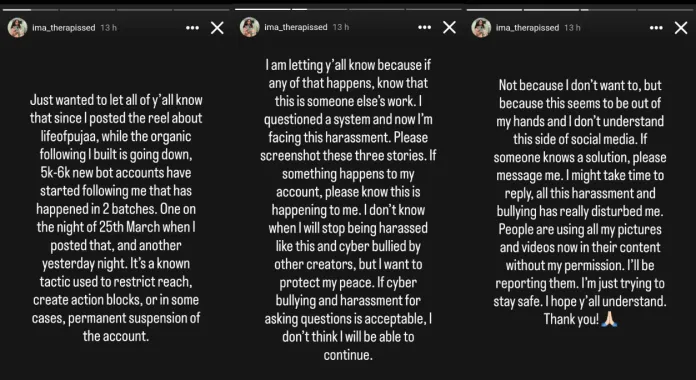
Following the backlash to her claims, Jain eventually made her social media account private. According to discussions on platforms like Reddit, she later posted three stories claiming she was the victim of cyberbullying. She also alleged that a sudden influx of 4,000 to 5,000 automated bot accounts began following her, describing it as a malicious tactic designed to ruin her account’s organic reach and engagement.
On the other side of the screen, Pradhan chose to address the controversy head-on with a dedicated response video. In it, she transparently explained her history with management. She revealed that her very first agency had allegedly exploited her financially. They offered to pay her a flat rate of ₹30,000 per day while secretly securing much larger, more lucrative deals from the brands behind her back. Realizing her worth, she left that toxic arrangement and eventually partnered with a new, more transparent team that now handles her brand deals with consistency and fairness.
In her video, she made one fact abundantly clear: the actual creative work—the scripting, the shooting, and the video editing—is done entirely by her, alone in her rural home. The agency only steps in to handle the corporate business side of things. This is a vital distinction, yet it is one that critics frequently ignore when debating a creator's worth.
What Defines a True Influencer
Today, being an influencer means much more than just randomly uploading videos to the internet. It is a demanding role that requires a mix of engaging storytelling, dedicated audience building, and sharp commercial viability.
Modern influencers operate like their own independent media companies. They are responsible for creating, editing, publishing, engaging with followers, and eventually monetizing their efforts. Their true value in the market relies entirely on the trust they build with their viewers and the steady consistency of their posts.
When viewed through this lens, Pradhan is not an exception to the rule. She is an active participant in a vast digital system where people turn their personal thoughts and daily expressions into profitable digital capital. The fact that she films from a rural village does not disqualify her from this system; it merely makes her success more visible and, for certain sections of society, deeply uncomfortable.
Why Brands Partner With Creators
Brands choose to collaborate with influencers for one very straightforward reason: guaranteed access to human attention. While traditional television or print advertising awkwardly pushes a corporate message outward, influencer marketing smoothly weaves that message into the voice of someone the audience already trusts. If a creator has spent years building a loyal following, the brand is essentially paying to borrow that hard-earned trust.
Pradhan’s successful collaborations with major, international brands prove that she has crossed a significant threshold of digital influence. She is no longer just a woman talking to a camera; she is an active, valuable player in a commercial ecosystem where her unique voice carries real, measurable financial weight.
 |
Agency Roles – Simple Middlemen or True Enablers
Management agencies exist specifically to bridge the intimidating gap between independent creators and massive corporate brands. They are there to negotiate fair deals, untangle complex legal contracts, and ensure that brand collaborations run smoothly and consistently.
For countless creators—especially those who come from non-urban, less privileged backgrounds—agencies open doors to financial opportunities they might never reach on their own. However, this business relationship is not always fair or balanced. As Pradhan’s own unfortunate experience with her first agency highlights, financial exploitation is a very real threat, especially when new creators are unaware of standard market rates and their own true value.
However, to claim that having an agency automatically makes a creator inauthentic shows a complete misunderstanding of how the entertainment industry works. In the vast majority of cases, agencies do not invent the creator's personality. They simply take the creator's existing identity, help polish it for a wider audience, and find ways to monetize it.
The Editing Debate – Does Polish Ruin Authenticity
One of the more subtle, lingering criticisms directed at Pradhan involves the visible jump cuts in her videos. Critics are quick to point out that her sentences are spliced together, her natural pauses are deleted, and her overall delivery is altered to sound smoother.
Yet, this is the standard operating procedure for the entire internet. Literally every successful creator edits their content. The real issue here is public perception. When a wealthy, highly polished urban influencer uses heavy editing, audiences praise them for their high production value and professionalism. But when a rural woman like Pradhan uses the exact same editing techniques, she is suddenly accused of "manufacturing" a fake persona.
There seems to be a deeply ingrained, unfair expectation that if a rural person wants to be seen as authentic, they must present themselves as raw, entirely unedited, and permanently flawed. People forget that even the deliberate display of imperfection is often just another form of careful curation.
|
Language, Accent, and the Unfairness of Mockery
A massive portion of the public reaction to Pradhan has nothing to do with what she is saying, but rather how she is saying it. Her relationship with the English language is constantly under the microscope.
Her rural pronunciation frequently becomes the butt of online jokes. Her thick accent is used as a metric to judge her intelligence. Despite this, she consistently responds with incredible composure, often managing to turn cruel mockery into positive audience engagement.
This dynamic exposes a much darker societal hierarchy. In India, speaking English is never just about communication; it is a heavy marker of social class and economic status. A person's accent, their level of fluency, and their tone act as immediate signals of whether they belong to the upper echelons of society.
When someone like Pradhan speaks English while completely ignoring these strict, unspoken social codes, it deeply unsettles the audience's expectations. It forces the public to confront a very uncomfortable question: exactly who gets the authority to decide what "good English" is supposed to sound like? To her credit, she recently proved her grace on the platform X (formerly Twitter) when she directly quoted a user who was mocking people for speaking English with poor pronunciation. She provided a thoughtful, decent reply without resorting to bitter sarcasm or playing the victim.
|
|
Elitism Opposed to True Authenticity
The overwhelming public fascination with Pradhan stems largely from this sharp visual and cultural contrast. Seeing a traditional rural setting paired with confident English-speaking content completely disrupts the long-standing, rigid association between language and social class in India.
Naturally, this disruption invites intense, almost microscopic scrutiny from the public. Critics point to old posts allegedly vanishing from her Instagram feed, note that her current visual style seems to align with a more trendy aesthetic, and highlight her lucrative brand deals. They use all of these factors to build a narrative that her entire existence is artificially "constructed".
The ironic truth, however, is that every single influencer on the internet is constructed to some degree. The only real difference is that some curated identities perfectly match what the wealthy, urban audience expects to see, while others wildly break the mold.
Who Judges What is Authentic
In the exhausting world of social media, "authenticity" is easily the most overused and least understood word. What actually makes a creator authentic? Is it showing the messy parts of their real life? Is it refusing to hire an agency? Is it intentionally leaving mistakes in a video, or does it simply depend on coming from a specific, acceptable background?
Pradhan’s own words perfectly capture the absurdity of this debate. She explicitly stated that she literally does not know how to "pretend to be authentic". That specific phrase is incredibly telling. It completely exposes the modern internet paradox: the concept of being "authentic" has actually become a rigid, highly demanding performance standard of its own.
The audience endlessly demands it, the social media algorithms financially reward it, and the creators are forced to navigate it daily. Yet, not a single person can clearly define what it actually is.
The Denim, the Past, and Showcasing of Identity
Recently, Pradhan posted a video that became a joyful moment of celebration for her followers. After formally asking for permission from her mother-in-law, she wore a pair of modern jeans paired with a traditional kurta for the very first time in years. She beautifully framed this as a massive personal milestone and a small, quiet victory for her own freedom of choice.
Interestingly, hawk-eyed viewers noticed that in a much older video, she had previously mentioned that she absolutely loved wearing jeans, which suggested that this style of clothing was not an entirely new concept to her. It is highly likely it was simply a personal preference she had been forced to abandon after getting married and moving into a more traditional household.
This small detail brilliantly highlights just how layered and complicated real human lives actually are. It proves that human identity is never frozen in time. It constantly shifts, bends, and adapts based on changing circumstances, strict family structures, and evolving personal choices.
But in the harsh, black-and-white world of influencers, any shift in behavior is immediately viewed as a suspicious contradiction. Audiences demand robotic continuity. They firmly believe that if a creator changes any aspect of their life from before they were famous, their new life must be fake, highly curated, and driven by a greedy agency—even though, as Pradhan shows, reality is far more complex.
|
Content Creators and Their Narrative Power
It is crucial to understand that influencers do much more than simply make entertaining videos. They possess the power to shape wide-scale public narratives. When Pradhan turns her camera on to discuss heavy topics like feminism, class divides, or the struggles of daily life, she is not just venting into the void. She is actively influencing how hundreds of thousands of people interpret these complex ideas.
This exact transfer of power is where the societal discomfort reaches its peak. Historically, the power to shape public narrative has always been reserved for very specific spaces: the urban elite, the highly educated, and those backed by wealthy institutions. When that same profound narrative power suddenly emerges from a rural village via a woman with a smartphone, the traditional gatekeepers question it far more aggressively than they would otherwise.
Far Beyond a Simple Digital Controversy
Ultimately, the ongoing saga surrounding Pujarani Pradhan is not just a fleeting drama about one single creator being called out. It is a massive, glaring spotlight on the deeply uneasy relationship between authenticity, social class, and digital visibility in modern India.
Her story perfectly illustrates how influencer culture loudly claims to democratize free speech, while still secretly clinging to outdated, inherited prejudices. It exposes how the role of management agencies is willfully misunderstood to fit a negative narrative, how video editing is only criticized when certain types of people do it, and how the English language still heavily functions as a societal gatekeeper.
Above all else, her journey forces us to face a very simple question that nobody seems able to answer: In a digital landscape where absolutely every single thing we consume is carefully curated, strictly edited, and aggressively monetized, what does it even mean to be real anymore?
 Support Us
Satyagraha was born from the heart of our land, with an undying aim to unveil the true essence of Bharat. It seeks to illuminate the hidden tales of our valiant freedom fighters and the rich chronicles that haven't yet sung their complete melody in the mainstream.
While platforms like NDTV and 'The Wire' effortlessly garner funds under the banner of safeguarding democracy, we at Satyagraha walk a different path. Our strength and resonance come from you. In this journey to weave a stronger Bharat, every little contribution amplifies our voice. Let's come together, contribute as you can, and champion the true spirit of our nation.
 |  |  |
| ICICI Bank of Satyaagrah | Razorpay Bank of Satyaagrah | PayPal Bank of Satyaagrah - For International Payments |
If all above doesn't work, then try the LINK below:
DISCLAIMER: The author is solely responsible for the views expressed in this article. The author carries the responsibility for citing and/or licensing of images utilized within the text. The website also frequently uses non-commercial images for representational purposes only in line with the article. We are not responsible for the authenticity of such images. If some images have a copyright issue, we request the person/entity to contact us at This email address is being protected from spambots. You need JavaScript enabled to view it. and we will take the necessary actions to resolve the issue.


