



More Coverage


Twitter Coverage

JOIN SATYAAGRAH SOCIAL MEDIA


"No more घर बैठे बैठे any विलायती डिग्री, नको": UGC takes a bold stand! Crackdown on EdTechs offering unapproved foreign degrees, safeguarding educational standards, ‘No foreign educational institutes can offer degrees in India without prior approval’

The University Grants Commission (UGC), a pivotal body in India's higher education system, has taken a significant stance regarding foreign educational institutions operating in India. The UGC's recent announcement focuses on the operations of EdTech companies that collaborate with foreign universities to offer degree and diploma courses in an online mode.
|
According to officials, the UGC will initiate action against any EdTech companies found to be offering such courses without the necessary approval. This decision underscores the importance the UGC places on regulating and maintaining the quality of higher education in India. The commission's mandate is to ensure that educational standards are upheld and that students receive legitimate and recognized qualifications.
In a detailed public notice, the UGC has clarified its position, stating emphatically that "no foreign higher educational institution can offer any programme in India without the prior approval of the commission." This statement implies that any foreign university wishing to offer educational programs in India, whether online or offline, must first seek and obtain approval from the UGC. The commission's approval process is designed to verify the quality and relevance of the programs offered, ensuring they meet the educational standards set by Indian authorities.
This decision by the UGC is pivotal in the context of the rapidly evolving educational landscape, where online learning and international collaborations are becoming increasingly common. The UGC's action aims to protect students in India from potentially unaccredited or unrecognized foreign degrees, which might not hold the same value as degrees from UGC-approved institutions. By enforcing this regulation, the UGC is also supporting the integrity of the Indian higher education system, ensuring that it remains robust and reliable.
|
The move is seen as a way to safeguard the interests of students by ensuring they have access to quality education that is recognized within the country's educational framework. It also emphasizes the need for foreign educational institutions to align with India's educational policies and standards if they wish to operate within its borders. The UGC's stance is a clear message that the commission is committed to upholding the standards of higher education in India and ensuring that the qualifications obtained by students are legitimate and valuable.
In a recent development that further emphasizes the University Grants Commission's (UGC) commitment to maintaining the quality and legitimacy of higher education in India, the Delhi High Court played a crucial role. In September, the court directed the UGC to take necessary action against universities and colleges that offer unspecified degrees. This directive was aimed at ensuring these institutions comply with the law, including adhering to penal provisions related to the issue.
This court order highlights the seriousness of the situation and underscores the government's commitment to protecting the interests of students and upholding the integrity of India's education system. The directive to the UGC is a clear indication that the judiciary supports the UGC's efforts to regulate educational offerings in India, especially those that might mislead or disadvantage students.
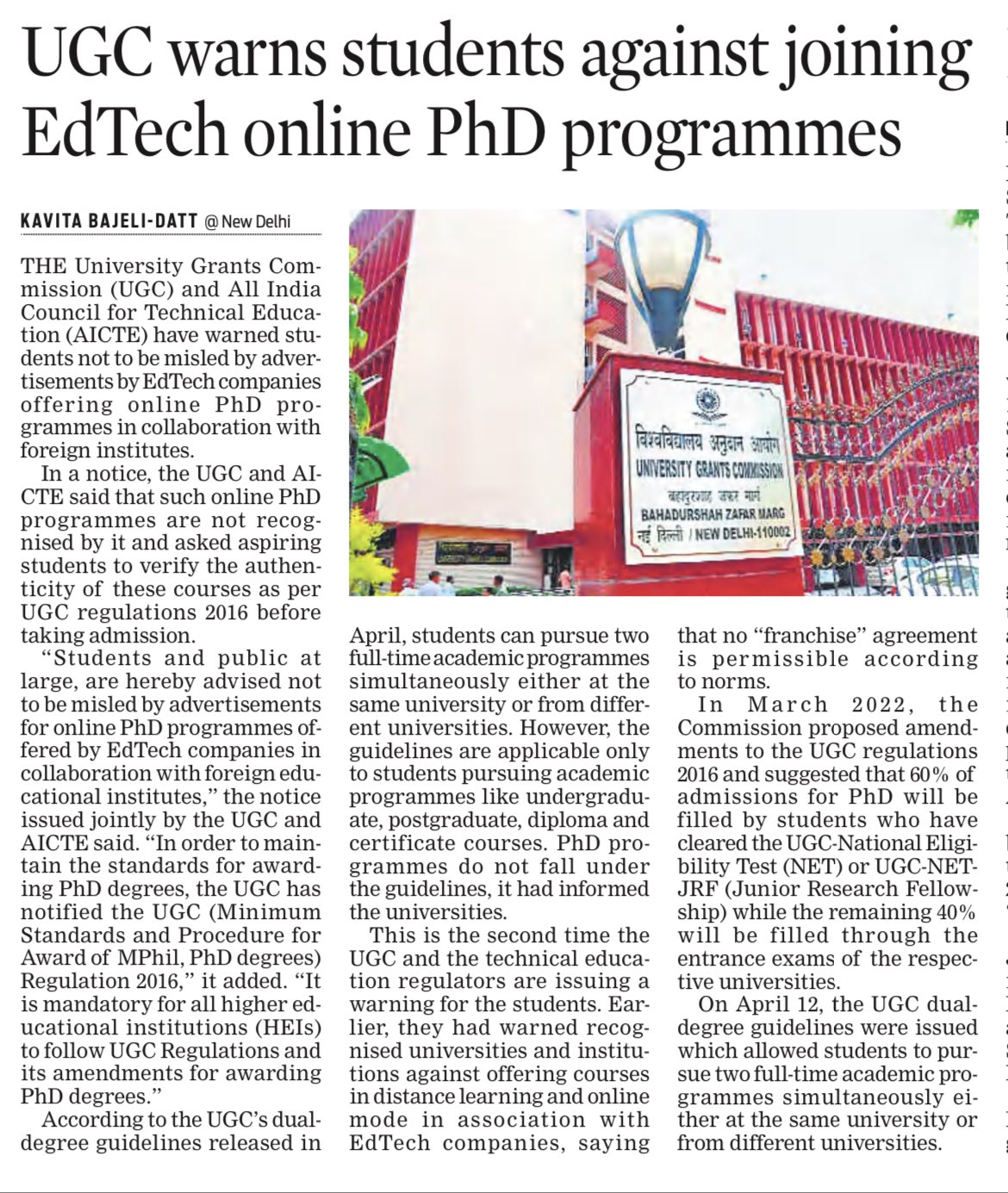 |
| Kavita Bajeli-Datt of The New Indian Express wrote in Oct'2022: "UGC warns students against joining EdTech online PhD programmes". |
Following this directive, the UGC issued a notice dated December 12, wherein it addressed a specific concern regarding the practices of some EdTech companies. The notice pointed out that these companies were advertising and offering degree and diploma programs in online modes in association with foreign universities and institutions. This is a significant observation because it sheds light on how some educational technology companies might be operating in a grey area, potentially bypassing the regulatory framework established by the UGC.
The UGC's notice is an important step in addressing these practices. By publicly acknowledging this issue, the UGC is not only alerting students and the general public about the potential risks associated with enrolling in such programs but is also holding these EdTech companies accountable for their actions. This move by the UGC demonstrates its proactive approach in ensuring that all higher education programs offered in India, whether by domestic or foreign institutions, meet the required standards and are in compliance with Indian laws.
The emphasis on compliance with the law, as directed by the Delhi High Court and reiterated in the UGC's notice, reflects a strong stance towards maintaining the sanctity of educational qualifications in India. The actions taken by the UGC, supported by the judiciary, aim to safeguard the future of students and ensure that their education and qualifications are both valuable and recognized within the established educational framework. This decision is indeed astounding as it represents a concerted effort to regulate and enhance the quality of higher education in a rapidly changing educational landscape.
|
For students, it means that degrees obtained through such non-permissible arrangements may not be recognized for further education or employment in India, affecting their future prospects. For institutions, it implies a need for strict adherence to UGC guidelines and regulations to ensure that their programs are valid and recognized.
Furthermore, the UGC's notice highlights the commission's readiness to enforce its regulations. It states, “Action will also be taken against all the defaulting EdTech companies as well as the HEIs under applicable laws, rules and regulations.” This statement is a firm warning to both EdTech companies and Higher Education Institutions (HEIs) that are currently in violation of these guidelines. The UGC is prepared to use the full extent of legal provisions to ensure compliance, indicating the seriousness with which it views these infringements.
The notice also sheds light on a concerning trend where many higher-education institutions and colleges in India have entered into collaborative agreements with foreign-based educational institutions and providers not recognized by the UGC. These institutions have been facilitating the issuance of degrees from these foreign entities to students enrolled in their programs. This practice is problematic because it circumvents the regulatory framework established by the UGC, potentially compromising the quality and legitimacy of the education provided to Indian students.
The UGC notice explicitly states, “Any such kind of collaboration or arrangement is not recognised by the University Grants Commission and accordingly, the degrees issued after such collaboration and arrangement are also not recognised by the Commission.” This statement is a clear and unambiguous message to all parties involved in higher education in India. It indicates that any collaboration or arrangement between Indian higher education institutions (HEIs) and foreign educational providers, which has not been approved by the UGC, will not be recognized.
What this means for students is particularly significant. If they enroll in a program that results from an unrecognized collaboration, the degree they receive upon completion will not be recognized by the UGC. This lack of recognition could have serious implications for their future career and educational opportunities, as many employers and educational institutions look for UGC-recognized degrees.
For educational institutions and EdTech companies, this statement serves as a strict reminder to adhere to the guidelines set by the UGC. They must ensure that any collaborative programs with foreign institutions have the necessary approvals and recognition from the UGC. Operating outside these guidelines could result in the invalidation of their programs and degrees, potentially damaging their reputation and trustworthiness.
 |
 Support Us
Satyagraha was born from the heart of our land, with an undying aim to unveil the true essence of Bharat. It seeks to illuminate the hidden tales of our valiant freedom fighters and the rich chronicles that haven't yet sung their complete melody in the mainstream.
While platforms like NDTV and 'The Wire' effortlessly garner funds under the banner of safeguarding democracy, we at Satyagraha walk a different path. Our strength and resonance come from you. In this journey to weave a stronger Bharat, every little contribution amplifies our voice. Let's come together, contribute as you can, and champion the true spirit of our nation.
 |  |  |
| ICICI Bank of Satyaagrah | Razorpay Bank of Satyaagrah | PayPal Bank of Satyaagrah - For International Payments |
If all above doesn't work, then try the LINK below:
DISCLAIMER: The author is solely responsible for the views expressed in this article. The author carries the responsibility for citing and/or licensing of images utilized within the text. The website also frequently uses non-commercial images for representational purposes only in line with the article. We are not responsible for the authenticity of such images. If some images have a copyright issue, we request the person/entity to contact us at This email address is being protected from spambots. You need JavaScript enabled to view it. and we will take the necessary actions to resolve the issue.


