


More Coverage


Twitter Coverage

JOIN SATYAAGRAH SOCIAL MEDIA


"जब नाश मनुज पर छाता है": The suspicious death of Raushan Anand's brother Prince Yadav in Nepal triggers fresh murder claims against his rival Khan Sir as a rushed 20-minute autopsy and friends' changing statements deepen the painful enigma

On the evening of June 21, 2026, the historic corridor from Patna College to Kargil Chowk in Bihar became a sea of flickering candlelight and echoing demands. Thousands of civil service aspirants, unified under the banner of the Gyan Bindu GS Academy, marched in solemn defiance.
|
This mass public demonstration was organized to demand the immediate registration of a First Information Report (FIR) for murder and criminal conspiracy against Faisal Khan, the celebrity educator universally known as "Khan Sir".
This street mobilization transformed what began as an administrative clash over marketing boards into a highly charged social movement. The immediate consequence of the march was the deployment of heavy police cordons across Patna’s academic hubs to prevent retaliatory violence against Faisal Khan's closed coaching facilities.
In the long term, the march demonstrated how deeply intertwined student loyalties are with the commercial fortunes of their tutors, effectively weaponizing the student body into a political force.
The primary contradiction of the evening lay in the student narratives: while demonstrators presented Prince Yadav as a tragic victim of a state-backed corporate execution, police records continued to classify him as an escaped rioter who fled the law to evade a lawful arrest. This public demonstration is documented through local administrative bandobast logs, widely circulated video archives of the march, and on-the-scene journalistic accounts.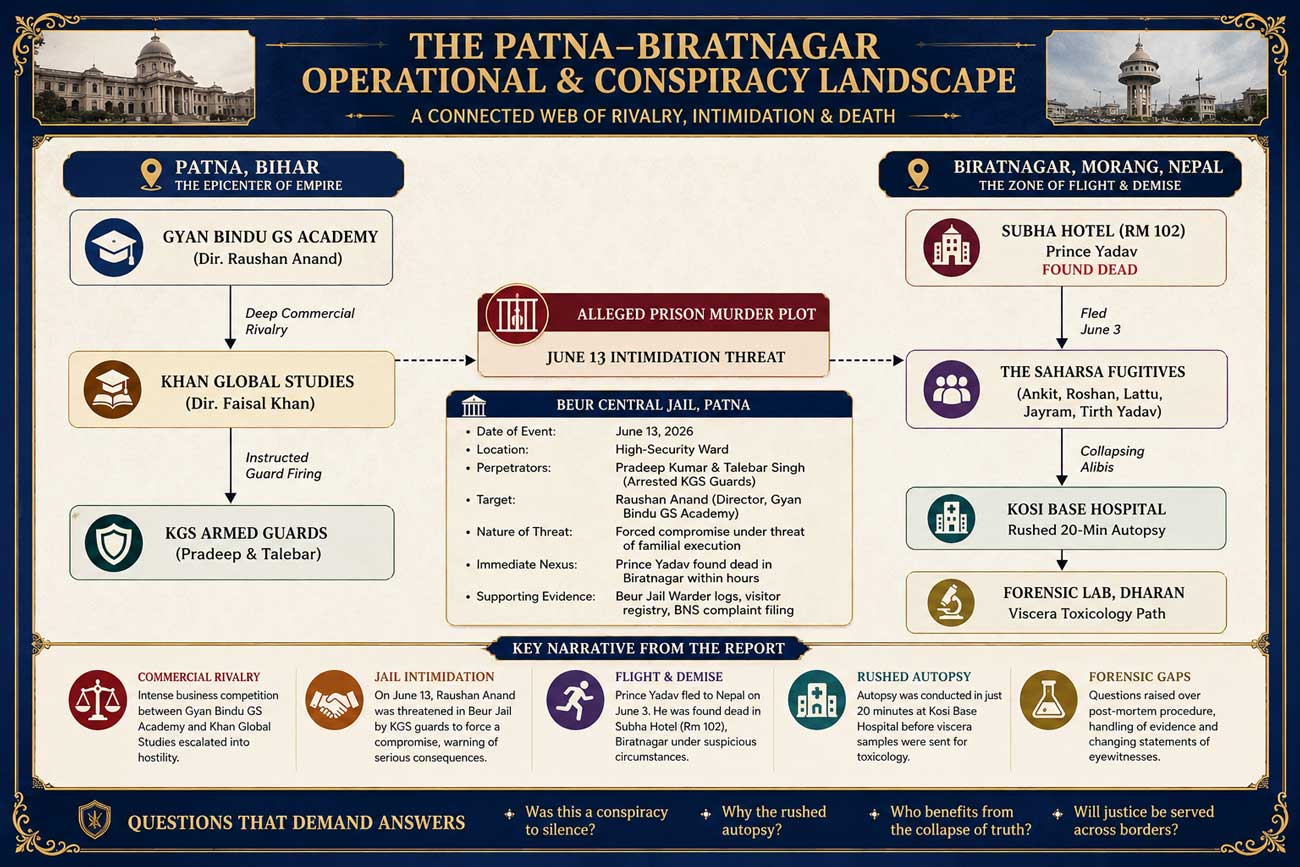
The Jurisdictional Impasse: International Law and Police Reluctance
Two days prior to the public protests, on June 19, 2026, the executive offices of the Kadamkuan Police Station and Patna Range Inspector General (IG) Jitendra Rana became the scene of a tense legal impasse. Patna Police commanders, facing a detailed written complaint from Gyan Bindu Director Raushan Anand, formally withheld the registration of an FIR, citing the complex extraterritorial jurisdictional issues of investigating a death that occurred inside the sovereign borders of Nepal.
The police accepted the physical petition but delayed formalizing it into a criminal case while seeking urgent guidance from the state's advocate general and legal advisors. This delay mattered because it prevented Indian police from taking custody of hotel logs, CCTV footage, and electronic devices from the crime scene in Biratnagar, allowing critical early-stage evidence to remain solely in the hands of local Nepalese authorities.
The immediate consequence of this legal gridlock was a growing public perception of administrative bias, which fueled rumors that Faisal Khan was receiving political protection from high-ranking government ministers.
The long-term impact has been a complete freeze in bilateral police cooperation, highlighting the lack of streamlined mutual legal assistance treaties for non-terrorism crimes along the Indo-Nepal border.
A central contradiction emerged during this phase: Patna High Court Advocate Kumaresh Singh publicly noted that under Section 188 of the Indian Code of Criminal Procedure (now reflected in modern BNS provisions), if a criminal conspiracy is actively planned or mobilized within Patna, the local police station holds the legal authority to register an FIR and initiate an investigation, regardless of where the eventual crime is executed. This legal stand-off is verified by police entry logs at the Kadamkuan station, official statements issued by IG Jitendra Rana, and formal legal assessments published by the Patna High Court Bar Association.
|
The Beur Jail Complaint: Jailhouse Intimidation and Conspiracy Files
On June 17, 2026, within forty-eight hours of his release on bail, Gyan Bindu GS Academy Director Raushan Anand filed a formal, written complaint at the Kadamkuan police station, alleging a coordinated criminal conspiracy to assassinate both him and his brother, Prince Yadav.
The document detailed a series of events inside Beur Central Jail in Patna, where Anand had been held following his arrest on June 3. Anand alleged that on June 13, 2026—the exact day his brother died in Nepal—he was approached and threatened by two arrested security guards associated with Khan Global Studies (KGS), Pradeep Kumar and Talebar Singh, who were also lodged in the same prison block.
The guards reportedly pressured him to sign a mutual legal compromise regarding the June 2 clash, delivering an ultimatum: settle the dispute, or face severe personal consequences.
==================================================================================================
                             THE BEUR CENTRAL JAIL THREAT METADATA
==================================================================================================
  - Date of Event:        June 13, 2026
  - Location:             High-Security Ward, Beur Central Jail, Patna, Bihar
  - Perpetrators:         Pradeep Kumar & Talebar Singh (Arrested KGS Guards)
  - Target:               Raushan Anand (Director, Gyan Bindu GS Academy) [cite: 7, 11]
  - Nature of Threat:     Forced compromise under threat of familial execution [cite: 7, 11]
  - Immediate Nexus:      Prince Yadav found dead in Biratnagar within hours [cite: 5, 7, 10]
  - Supporting Evidence:  Beur Jail Warder logs, visitor registry, BNS complaint filing
==================================================================================================
This complaint was critical because it established a direct temporal link between the physical intimidation of Anand in a Patna prison and the death of his brother in a Nepalese hotel room hundreds of kilometers away.
The immediate consequence of this filing was an internal investigation by the Beur Jail administration into the movement of inmates within the facility.
The long-term impact was the formal request by the defense for a Central Bureau of Investigation (CBI) probe, arguing that local police could not conduct an impartial inquiry.
A major contradiction lies in the jail records: prison administrators claimed that the high-security cells of the rival groups were strictly segregated, making any direct physical interaction or verbal intimidation impossible under standard prison regulations. This phase of the investigation is documented in the filed BNS complaint dossier and the official visitor and inmate movement logs of Beur Central Jail.
The Press Conference of the Jailed Brother: Sibling Grief and War Declared
On June 15, 2026, immediately after securing bail from a Patna sessions court and returning to the offices of the Gyan Bindu Academy, Raushan Anand held an emotional press conference. Surrounded by hundreds of supportive students who shouted slogans of "Faizal Khan Go Back," Anand broke down in tears as he publicly accused Faisal Khan and RS Prasad, the owner of the Kisan Cold Store, of plotting and executing the murder of his brother.
Anand claimed that his brother’s death was a calculated hit designed to break his family's resolve and force them to abandon their rival coaching operations.
This press conference was a watershed moment, shifting the narrative from a corporate rivalry to an active murder investigation in the public eye.
The immediate consequence was an immediate escalation of political involvement, as Rashtriya Janata Dal (RJD) leader Tej Pratap Yadav publicly backed Anand's claims, demanding that Khan Sir be sent to jail.
The long-term impact was a complete halt to classes at both major coaching institutes, paralyzing the competitive examination market in Patna.
The core contradiction of this event was Faisal Khan’s concurrent release of a video message, in which he expressed deep condolences to the bereaved family while characterizing the murder allegations as a sinister conspiracy hatched by an anonymous third party looking to profit from their rivalry. This confrontation is documented by live television broadcasts, video statements from both educators, and press releases from the Janashakti Janata Dal.
|
The Suspicious Autopsy: Twenty Minutes at Kosi Hospital
On the morning of June 14, 2026, at the Kosi Hospital in Biratnagar, Nepal, the body of Prince Yadav underwent a highly irregular and rushed post-mortem examination.
The autopsy, which typically requires a minimum of two hours of meticulous internal evaluation, was completed in just twenty minutes.
According to investigative reports, the medical team neglected to examine vital organs, including the lungs and tongue, did not open the heart despite making a preliminary incision, and completely ignored a noted injury on Yadav's head.
==================================================================================================
                              FORENSIC PROTOCOL ABERRATION BOARD
==================================================================================================
  Forensic Metric        Standard Pathology Protocol        Kosi Hospital Execution
  ---------------------+----------------------------------+---------------------------------------
  Total Duration         120 to 180 Minutes                 20 Minutes
  Forensic Supervision   Certified Pathologist Required     Zero Experts Present
  Cranial Trauma         Detailed Skull & Brain Dissection  Ignored Head Injury
  Cardiac Analysis       Chamber Sectioning & Mass Check    Incision Only; Not Opened [cite: 16]
  Pulmonary/Tongue       Full Tissue Extraction             Unexamined [cite: 16]
  Toxicology Screen      In-situ Chemical Testing           No Alcohol/Poison Tests [cite: 19, 20]
  Primary Conclusion     Clear Pathological Cause           Declared "Inconclusive"
==================================================================================================
This rushed examination was highly controversial, sparking immediate allegations of a forensic cover-up.
The immediate consequence was that the doctors issued an inconclusive preliminary report, stating the cause of death could not be determined without a full viscera test.
In the long term, this compromised autopsy means that even if a second examination is ordered by Indian courts, the decomposition of the body and the loss of pristine tissue samples may prevent any definitive determination of foul play.
A major contradiction emerged: while Nepalese police sources claimed the autopsy showed "no signs of foul play" and pointed to a generic heart condition, a senior doctor at Kosi Hospital, speaking on the condition of anonymity, revealed that the body bore signs consistent with homicide.
The doctor further claimed that no forensic expert was present and that the medical team was under heavy pressure from local police to quickly clear the body from the hospital. This forensic failure is documented in the preliminary autopsy report issued by Kosi Hospital, investigative reports, and the official transfer files of the viscera samples sent to the laboratory.
|
The Shubh Hotel Incident: Shifting Alibis and Border Arrests
Late on the night of Saturday, June 13, 2026, inside Room 102 of the Subha Hotel at Traffic Chowk, Biratnagar, Prince Yadav fell unconscious and died under mysterious circumstances.
Yadav had been hiding in Nepal since June 3 to evade arrest in India. He was accompanied by four Indian friends from Saharsa—Ankit Kumar Yadav, Roshan Yadav, Lattu (Laddu) Yadav, and Jayram Yadav—along with his Nepalese cousin, Tirth Kumar Yadav.
At 10:30 PM, Yadav reportedly took unspecified medicines before his condition rapidly deteriorated, leading to him being declared dead on arrival at the Neuro Hospital in Biratnagar by 11:30 PM.
==================================================================================================
                              THE ALIBI DEGRADATION CHRONOLOGY
==================================================================================================
  - PHASE 1: THE PUBLIC STATEMENT (June 14, 2026)
    * Companion Claim: "We were all present in Room 102 when Prince became ill. We acted as a
      cohesive rescue unit to transport him to the Neuro Hospital."
    * Tactical Intent: Establish a shared, innocent alibi of immediate medical response.

  - PHASE 2: THE POLICE INTERROGATION (June 15, 2026)
    * Companion Claim: "Only Laddu Yadav was present in Room 102 with Prince. The other four
      companions had crossed the border back into India to visit Jogbani."
    * Tactical Intent: Distribute responsibility and distance key individuals from the room.

  - PHASE 3: THE CONFESSION (June 16, 2026)
    * Companion Claim: "Laddu Yadav was inside the room. Prince consumed unidentified medicines,
      leading to sudden respiratory failure." [cite: 9, 18]
    * Tactical Intent: Minimize exposure to potential homicide or poisoning charges.
==================================================================================================
This event was the critical turning point that brought the Patna coaching rivalry into the realm of international criminal investigation.
The immediate consequence was the arrest of all four Indian companions by the Nepal Police after their conflicting alibis raised suspicion.
The long-term impact was a complex cross-border investigation, with Indian families accusing Nepalese authorities of failing to properly secure the hotel room and key evidence.
The primary contradiction remains the cause of the head and eye injuries observed on Yadav's body: his companions claimed they occurred during his sudden collapse, while family members point to them as clear evidence of a physical struggle and assault. This sequence of events is detailed in the guest registries of the Metro City and Subha Hotels, the Neuro Hospital admission records, and the formal arrest sheets issued by Morang DSP Makendra Kumar Mishra.
|
The Protection of the Influencer: Judicial Stays and Guard Confessions
On June 9, 2026, a Patna civil court granted interim protection from arrest to Faisal Khan, staying any custodial action by the police until June 20.
This judicial relief was granted after Khan’s defense team argued that the attempted murder charges against him were politically motivated and lacked direct evidence.
This ruling was critical because it allowed Khan to remain free and run his media empire, while his rival Raushan Anand remained behind bars at Beur Central Jail.
The immediate consequence was deep resentment among Gyan Bindu Academy students, who accused local authorities of selective enforcement and protecting a highly influential figure.
The long-term impact was the entrenchment of two opposing student factions in Patna, turning the city's coaching districts into highly volatile zones.
A central contradiction emerged from the statements of KGS security guards Pradeep Kumar and Talebar Singh: while Faisal Khan’s legal team argued that the guards had acted independently in self-defense to protect the building, the guards' official confessions stated they had discharged their firearms into the air on Khan’s direct, verbal instructions. This judicial phase is documented in the Patna Sessions Court interim protection order sheets and the official interrogation reports of the arrested guards.
|
The Viral Firing Video: Confessions under Interrogation
On June 4, 2026, mobile phone video footage of the June 2 clash outside the KGS Musallahpur Haat branch went viral across major social media platforms.
The video clearly showed KGS security guards Pradeep Kumar and Talebar Singh firing live ammunition into the air as a crowd of protesting students retreated.
The Patna Police immediately seized the weapons for ballistics testing and took both guards into custody.
==================================================================================================
                             THE VIRAL VIDEO METADATA & BALLISTICS
==================================================================================================
  - Video Release Date:   June 4, 2026
  - Location of Firing:   Musallahpur Haat Branch, Khan Global Studies, Patna [cite: 6, 7, 11]
  - Weapons Discharged:   Licence-registered semi-automatic firearms
  - Key Capture:          Guards Pradeep Kumar & Talebar Singh firing into crowds
  - Guard Confession:     "We discharged weapons on the verbal orders of Faisal Khan."
  - Ballistics Match:     Fired shells recovered from the scene match seized weapons
==================================================================================================
This video evidence was a critical development, forcing the Patna Police to expand their investigation beyond the vandalism claims and book Faisal Khan for attempted murder and weapons violations.
The immediate consequence was the arrest and detention of the two security guards, whose subsequent bail applications were rejected.
The long-term impact was a severe blow to Khan’s public image, shifting his reputation from an accessible online educator to a powerful corporate operator utilizing armed security.
A major contradiction emerged: while KGS management initially claimed that no live rounds had been fired and that the sounds were firecrackers set off by the rioters, the ballistics report confirmed that the recovered shells matched the guards' service weapons. This phase of the investigation is supported by the digital forensic reports of the video, the police seizure memos for the firearms, and the ballistics logs.
The Pre-Dawn Arrest: Decapitating the Rival Academy
At 4:00 AM on June 3, 2026, a heavy contingent of Patna Police conducted a pre-dawn raid, arresting Gyan Bindu GS Academy Director Raushan Anand and two student leaders, Prince Gaurav and Abhishek.
The raid was executed within hours of the initial clash, based on an FIR filed by KGS manager Kanhaiya Kumar Singh.
The arrest was highly significant, as it effectively left Gyan Bindu Academy without its leadership and forced Prince Yadav to immediately flee across the border into Nepal to avoid a similar fate.
The immediate consequence of the raid was a wave of student protests outside the Kadamkuan police station, with demonstrators accusing the police of acting with unusual speed to protect Faisal Khan's interests.
The long-term impact was the complete disruption of the academic calendar for thousands of civil service aspirants, as Gyan Bindu's classrooms were locked by administrators.
The central contradiction lay in the arrest warrant: while the police justified the pre-dawn raid by citing Anand’s prior history of organizing student protests, his legal defense team presented evidence showing that Anand was miles away from the scene of the clash on the night of June 2, arguing that his arrest was a case of collective punishment. This event is documented in the Patna Police arrest logs, the jail admission records of Beur Central Jail, and the initial bail petitions filed by the defense.
The Musallahpur Haat Turf War: Banners, Bricks, and the Spark of June 2
The entire cross-border crisis was sparked on the night of June 2, 2026, by a physical confrontation outside the local KGS facility in Patna’s Musallahpur Haat.
The initial dispute began when staff members from Gyan Bindu GS Academy attempted to remove promotional banners placed by KGS, claiming they blocked their own marketing materials.
The disagreement quickly escalated, with a crowd of fifteen to twenty individuals allegedly associated with Gyan Bindu Academy attacking the KGS building.
The attackers vandalized the lobby, tore down billboards, and assaulted KGS security guard Chun Chun, who suffered severe head trauma from brick-batting.
==================================================================================================
                         THE SPARK OF JUNE 2: CONFLICT SEQUENCE
==================================================================================================
  - Time of Event:        9:30 PM to 11:00 PM, June 2, 2026 [cite: 12, 13]
  - Location:             Musallahpur Haat Area, Patna, Bihar
  - Primary Dispute:      Removal of commercial banners and poster placement
  - Physical Escalation:  Brick-batting by Gyan Bindu supporters
  - Casualties:           Severe head injuries sustained by Guard Chun Chun
  - Police Response:      Filing of FIR No. 412/26; deployment of riot police
==================================================================================================
This clash was the spark that ignited the broader conflict, exposing the intense commercial rivalries within Patna's coaching industry.
The immediate consequence was the filing of the initial FIR, which named both Raushan Anand and Prince Yadav as primary conspirators.
In the long term, the event exposed how competitive exam tutoring has become a highly lucrative and aggressive corporate battleground, where physical turf is defended with force.
A key contradiction of the night was the dispute over gunfire: while Faisal Khan claimed that the attackers had fired eight to ten rounds at his staff, the Patna Senior Superintendent of Police (SSP) publicly denied that any shots had been fired by the crowd, stating that the guard's injuries were caused solely by thrown bricks. This initial confrontation is documented in the filed complaints, emergency medical reports from the Patna Medical College Hospital, and local CCTV footage.
The Backstory: The Forest Topper Dispute and the 2021 Altercation
The deep animosity between Faisal Khan and Raushan Anand was not a sudden development; it was built on years of commercial rivalry and a previous physical confrontation in 2021, where Prince Yadav had been named as an accused for vandalizing Khan Sir's center.
The commercial tension reached a boiling point in early 2026 over a dispute regarding Abhishek Patel, the state topper of the Bihar Forest Range Officer examination.
Both KGS and Gyan Bindu Academy claimed Patel as their exclusive student, using his face on massive billboards across Patna to attract new students.
==================================================================================================
                         THE ARCHIVAL FEUD MATRIX (2021 - 2026)
==================================================================================================
  - The 2021 Attack:      Prince Yadav named as primary accused for vandalism and assault at
                          Khan Sir's coaching centre.
  - The Topper Battle:    Both schools claim Forest Range Officer topper Abhishek Patel.
  - The Library Raids:    Allegations that Faisal Khan utilized administrative influence to close
                          independent student libraries associated with Gyan Bindu [cite: 13].
  - The Cold Store Nexus: Alliance between KGS and RS Prasad of Kisan Cold Storage, creating
                          a powerful commercial block in Kadamkuan [cite: 13].
==================================================================================================
This ongoing marketing dispute was highly significant, as it escalated the rivalry from simple business competition to a deeply personal feud.
The immediate consequence was a series of retaliatory measures, with each institute trying to disrupt the other's classes and marketing efforts.
The long-term impact was the normalization of intimidation tactics within Patna's coaching sector, creating an environment where a minor dispute over poster placement could lead to cross-border flight and a suspicious death.
The core contradiction of this rivalry is the academic image both educators present to their millions of online followers, which stands in stark contrast to the physical turf wars and legal battles fought by their operations behind the scenes. This history is documented in Patna municipal advertising dispute logs, the 2021 police records, and archival marketing materials from both academies.
Present-Day Status and Systemic Impact
As of mid-2026, the investigation into Prince Yadav's death remains at a complete standstill, caught in a complex web of international borders and legal jurisdictions. The Morang District Police in Nepal continue to hold his four Indian companions in custody, waiting for the critical viscera toxicology report to determine the exact cause of death.
In Patna, the police have withheld the registration of a formal murder FIR, citing their lack of jurisdiction over crimes committed in Nepal, while Raushan Anand's legal team prepares to petition the Patna High Court for a direct CBI intervention.
The systemic impact of this case has been deeply felt across Bihar's multi-million dollar coaching industry. The state government has announced a series of new, strict guidelines aimed at regulating these large academies, including mandatory registration, background checks for private security staff, and strict rules regarding student enrollment and marketing displays.
For the millions of students who flock to Patna every year in search of a better future, the case has been a sobering reminder of the dark, commercial forces that run the city's private educational institutions. What began as a promise of academic advancement has been overshadowed by a story of corporate rivalry, cross-border flight, and a young man's unresolved death in a quiet Nepalese hotel room.
 Support Us
Satyagraha was born from the heart of our land, with an undying aim to unveil the true essence of Bharat. It seeks to illuminate the hidden tales of our valiant freedom fighters and the rich chronicles that haven't yet sung their complete melody in the mainstream.
While platforms like NDTV and 'The Wire' effortlessly garner funds under the banner of safeguarding democracy, we at Satyagraha walk a different path. Our strength and resonance come from you. In this journey to weave a stronger Bharat, every little contribution amplifies our voice. Let's come together, contribute as you can, and champion the true spirit of our nation.
 |  |  |
| ICICI Bank of Satyaagrah | Razorpay Bank of Satyaagrah | PayPal Bank of Satyaagrah - For International Payments |
If all above doesn't work, then try the LINK below:
DISCLAIMER: The author is solely responsible for the views expressed in this article. The author carries the responsibility for citing and/or licensing of images utilized within the text. The website also frequently uses non-commercial images for representational purposes only in line with the article. We are not responsible for the authenticity of such images. If some images have a copyright issue, we request the person/entity to contact us at This email address is being protected from spambots. You need JavaScript enabled to view it. and we will take the necessary actions to resolve the issue.


