



More Coverage


Twitter Coverage

JOIN SATYAAGRAH SOCIAL MEDIA


"एक आह भरी होगी": In Lucknow's Aliganj on Usha Mehta Marg, a devastating fire at a coaching center killing fifteen young students and leaving seven injured, prompting a strict statewide inquiry by the Deputy Chief Minister Brajesh Pathak

On the afternoon of Monday, June 22, 2026, the leafy lanes of Aliganj—a premium residential neighborhood in north Lucknow increasingly converted into commercial hubs—became the site of a tragic disaster. At approximately 3:00 PM, a plume of dark, toxic smoke rose from a three-storey commercial complex located at B-2, Sector D, on Usha Mehta Marg. Within minutes, the building, which housed a pet clinic on the ground floor and an animation and gaming training center on its upper levels, was transformed into a concrete furnace.
Students trapped on the upper floors were forced to choose between jumping from windows onto the concrete below or retreating into windowless rooms. By nightfall, King George’s Medical University (KGMU) Trauma Centre confirmed that 15 people had died, mostly young adults aged between 20 and 24.
This tragedy is part of a larger pattern of systemic failures. Similar structural traps and regulatory gaps were documented in the 2019 Surat Takshashila Arcade fire and the 2023 Delhi Mukherjee Nagar fire. This investigation reconstructs the Lucknow disaster, traces its underlying causes, and maps the policy failures that continue to compromise urban safety.
|
The Anatomy of a Vertical Trap
The commercial complex on Usha Mehta Marg was designed as a multi-occupancy facility with high electrical demands and restricted exits. The architectural layout and structural modifications made to accommodate commercial activities created a highly hazardous environment.
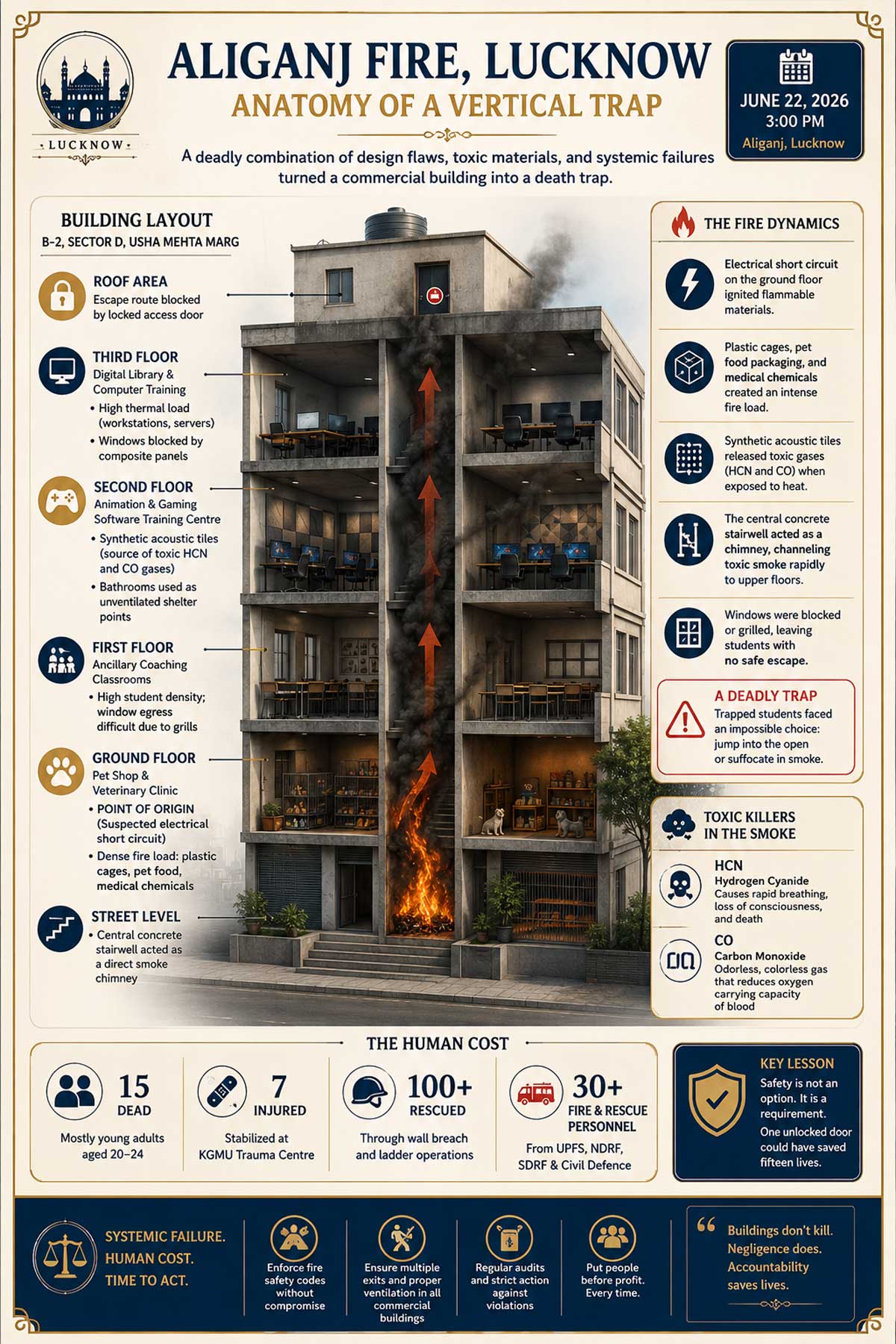
The Fire Load and Chimney Effect
The fire originated on the ground floor, which was occupied by a pet shop and veterinary clinic containing plastic pet carriers, synthetic pet food packaging, and flammable medical solvents. A suspected electrical short circuit quickly ignited these materials, blocking the building’s single entrance and exit route.
The upper floors housed dozens of high-end computer workstations, server units, UPS backup systems, and continuous air conditioning systems. To control sound and light for digital animation work, the operators had lined the classrooms with synthetic acoustic paneling. When the fire reached these panels, they released thick black smoke containing high levels of carbon monoxide and hydrogen cyanide.
As the heat rose, the central concrete stairwell acted as a chimney, drafting the toxic gases upward and cutting off the primary evacuation path.
|
|
Systemic Failures: A Chronological Record
Tracing the tragedy of June 22, 2026, back through its regulatory and historical precedents reveals a pattern of structural safety compromises.
The Chronological Matrix (June 2026 – June 2001)
| Date & Location | Entities Involved | Event & Regulatory Action | Immediate Consequences | Long-Term Impact | Contradictions & Evidence |
Late June 2026 Lucknow, UP | UP Fire Services, Local Municipalities, Coaching Operators | UP Government initiates state-wide safety audits of all commercial hubs. | Over 120 unregulated institutions receive immediate closure or rectification notices. | Accelerated shift of commercial operators to compliant complexes; increased demand for structural code revisions. | Contradiction: Operators claim audits are temporary public relations measures rather than a structural fix. |
June 22, 2026 (~18:00 IST) KGMU Trauma Centre, Lucknow | CM Yogi Adityanath, Deputy CM Brajesh Pathak, KGMU CMS Prof. Premraj Singh | Death toll reaches 15; 7 injured are stabilized. State orders a high-level inquiry. PM Modi announces ex-gratia of ₹2 lakh per deceased from the PMNRF. | Public protests break out in Aliganj; authorities seal adjacent buildings over fire safety lapses. | Heightened scrutiny on municipal authorities for issuing licenses to unventilated commercial spaces. | Contradiction: Early official reports estimated 4 deaths, later updated to 15 by medical superintendents. |
June 22, 2026 (~16:30 IST) Aliganj, Lucknow | UP Fire Services, NDRF, SDRF, Local Civil Defence | Emergency teams use heavy tools to breach the second-floor brick wall of an adjacent residential structure. | Rescuers bypass the burning stairwell, evacuating trapped students on stretchers through the wall breach. | Highlights the critical need for mandatory secondary exit staircases on commercial properties. | Evidence: Visual records and statements from Deputy CM Pathak detailing tactical wall breaches. |
June 22, 2026 (~15:00 IST) Aliganj, Lucknow | Trapped Students, Local Residents (Aman, Shakeel Ahmed) | A fire starts near the ground floor, trapping students on upper levels. Several jump from first-floor windows. | Students sustain impact injuries; several retreat to unventilated washrooms and suffocate. | Immediate loss of young lives, highlighting the danger of unventilated rooms during fires. | Evidence: Recorded emergency calls and witness testimonies from residents on-site. |
October 24/25, 2025 Aliganj, Lucknow | Building Owner Amarjeet Singh, Lucknow Fire Department | A major fire breaks out at a four-storey commercial warehouse in Aliganj, injuring five firefighters. | Structural portions collapse; adjacent homes are evacuated due to high concentration of burning plastics. | Identified Aliganj as a high-risk zone for electrical overloads and illegal commercial storage. | Evidence: Incident logs and hospital records of injured firefighters at Bhaurao Deoras Hospital. |
January 18/19, 2024 New Delhi | Union Ministry of Education (MoE) | MoE issues national Guidelines for Regulation of Coaching Center, banning enrollment under 16. | Sets safety baselines, including a 1 sq. meter space requirement per student and mandatory fire NOCs. | Highlighted the regulatory gaps for non-academic vocational training centers. | Evidence: Official gazette notification and guidelines released by the Higher Education Department. |
June 15, 2023 Mukherjee Nagar, Delhi | Delhi Fire Service, Coaching Operators (S. Mishra, S. S. Bharti) | A ground-floor electrical fire at Bhandari House traps over 200 students. | 61 students are injured while descending using wires; two coaching operators are arrested. | High Court orders comprehensive fire safety sweeps of all commercial properties in student hubs. | Evidence: FIR lodged at Mukherjee Nagar Police Station under IPC Sections 336, 337, and 338. |
May 24, 2019 Sarthana, Surat | Smart Design Studio, Surat Municipal Corporation | Electrical short circuit sparks a fire that destroys a wooden stairwell at Takshashila Arcade, killing 22 students. | Nationwide outrage leads to the arrest of three individuals and a temporary shutdown of coaching centers in Gujarat. | Emphasized the hazard of illegal makeshift construction and lack of secondary exits. | Evidence: Charge sheet filed by Gujarat Police and fire safety inspection logs. |
2013 Surat, Gujarat | Property Builders, Surat Municipal Corporation | Unauthorized commercial extensions on the upper floor of Takshashila Arcade are regularized under the Gujarat Regularization of Unauthorized Development Act. | The illegal third floor is granted statutory compliance in exchange for an impact fee. | Demonstrated how regularization laws can allow structurally unsafe spaces to continue operating. | Evidence: Land registry documents and municipal regularization certificates. |
2007 Surat, Gujarat | Property Developers, Sarthana Local Authority | A multi-storey commercial complex is constructed on a site approved for a residential project. | The site is converted into a dense student hub without standard commercial fire safety setbacks. | Created the physical layout that later contributed to the 2019 fire. | Evidence: Site maps and municipal zoning violations records. |
June 2001 Surat, Gujarat | Surat Urban Development Authority (SUDA) | SUDA approves a residential housing scheme on the Takshashila Arcade site. | Original municipal master plan reserves the plot strictly for low-density residential use. | Establishes the baseline zoning before commercial conversion. | Evidence: SUDA master planning records and land allotment files. |
Human Stories and Eyewitness Testimonies
Behind the statistics are the personal accounts of students and local residents who witnessed the disaster.
|
|
The Agonizing Final Call
For Shakeel Ahmed, the Aliganj fire is marked by a final phone call from his younger brother. As smoke cut off the main staircase, his brother and several classmates sought refuge in a third-floor bathroom, hoping the concrete walls would shield them from the heat.
During the rescue operation, Ahmed recounted the conversation:
"He called and said, 'Bhaiya, five-six people are locked inside a bathroom.' After that, there was no contact. We have not heard from him since."
Firefighters later confirmed that several victims were found huddled in the unventilated bathrooms, having succumbed to carbon monoxide poisoning.
                     STREET LEVEL RESCUE & ESCAPE PATTERNS

        [Upper Windows] ------------------> [Desperate Leap to Safety]
              |                                     |
              | (Thick Black Smoke)                 v [Sustains Fractures]
              v
        [Interior Corridors] -------------> [Unventilated Bathrooms]
                                                    |
                                                    v [Fatal Asphyxiation]
The First Responder on the Ground
Aman, a resident of Aliganj, was among the first to reach the building when the smoke appeared. Before emergency services arrived, Aman and other locals attempted to assist those escaping from the lower levels.
"There is a library or a computer course institution here. When we reached, we saw smoke coming from the building. We saved five to six people. After the fire broke out, a man jumped from the building in panic and was seriously injured. There are still some people trapped inside."
|
|
The Regulatory Gap: Navigating the 2024 Coaching Guidelines
The Lucknow tragedy highlights a major enforcement gap in the Guidelines for Regulation of Coaching Center issued by the Union Ministry of Education in January 2024.
                 STATUTORY GUIDELINE VS. PRACTICAL EVASION

  MoE 2024 Rule: Bounded to "Academic Tutoring (50+ students)"
  Evasion Method: Rebrand as "Software Skill Studio" or "IT Workspace"
  Result: Bypasses fire safety checks mandated for academic institutions.

  MoE 2024 Rule: Requires 1 Sq. Meter per student during active batches
  Evasion Method: Over-enrollment during peak competitive seasons.
  Result: Crowded rooms with limited exit routes during emergencies.
While the 2024 guidelines set standards for academic coaching centers, they are often evaded by commercial training centers through strategic rebranding.
The Rebranding Strategy: Because the MoE guidelines specifically target academic preparatory institutes (for exams like JEE, NEET, and UPSC), vocational, design, and IT software training centers frequently operate under standard commercial licenses. This allows them to bypass the strict student capacity limits and structural safety checks mandated for academic coaching centers.
The Static Fire Certificate System: Fire Safety Certificates (NOCs) are typically issued based on static physical layouts. However, commercial properties frequently alter their interior spaces with plywood partitions, synthetic cabin dividers, and server racks, which increases the fire load and can block exits.
Enforcement Disconnection: Municipal planning authorities often lack the resources for continuous monitoring, resulting in a system that relies on reactive inspections following major safety incidents.
|
|
Structural Traps: A Comparative Analysis
The fires in Lucknow, Delhi, and Surat share several common physical and regulatory factors, illustrating the systemic hazards present in dense urban commercial conversions.
                  THE TRIPLE NEXUS OF URBAN FIRE HAZARDS

                  +-----------------------------------+
                  |      High Electrical Loads        |
                  |  - Multiple AC units              |
                  |  - High-end computer servers      |
                  +-----------------+-----------------+
                                    |
                                    | (Triggers spark)
                                    v
                  +-----------------+-----------------+
                  |      Interior Alterations         |
                  |  - Flammable soundproofing        |
                  |  - Plywood partition walls        |
                  +-----------------+-----------------+
                                    |
                                    | (Accelerates smoke)
                                    v
                  +-----------------+-----------------+
                  |       Structural Barriers         |
                  |  - Window grills / glass facades  |
                  |  - Single, narrow stairwells      |
                  +-----------------------------------+
The Modification Trap
In all three cases, residential or light-commercial structures were modified to maximize rentable space. To soundproof the visual animation rooms in Lucknow and Surat, operators installed low-cost acoustic insulation. These materials catch fire easily and produce dense, toxic smoke that quickly fills escape routes.
The Point of Origin and Chimney Design
In both Lucknow and Delhi, the fire originated on the ground floor near the main electrical meters or distribution points. Because these buildings lacked external fire escapes or secondary exit stairs, the main stairwell quickly filled with smoke, trapping occupants on the upper floors.
The Window Egress Barrier
During the Lucknow and Delhi fires, students were trapped behind reinforced glass or window security grills. This left them with few options: they had to wait for rescuers to cut through the metal barriers or attempt dangerous jumps from the few open windows.
|
Actionable Reforms for Urban Planning and Safety
The recurrence of these fatal fires indicates that paper-based compliance checks are insufficient to ensure safety in dense commercial areas. Preventing future tragedies requires structural modifications and modern enforcement mechanisms.
                  RECONSTRUCTING COHERENT URBAN SAFETY

   [Analog Past]                                      [Digital Future]
   - Manual, periodic inspections  ===============>   - Continuous load monitoring
   - Static Fire NOC papers                           - QR-coded safety registries
   - Single central stairwells                        - Mandatory steel external escapes
1. Mandatory External Steel Fire Escapes
Municipal building bylaws must be updated to require all multi-storey commercial and educational spaces to install an external steel fire escape staircase. This escape route must be structurally independent of the main building and directly accessible from every floor.
2. Live Electrical Load and Thermal Monitoring
Because these commercial conversions house dense configurations of computers and air conditioning units, property owners should be required to install automated thermal sensors and smart circuit breakers at main distribution boards. These systems can monitor real-time electrical loads and automatically cut power if temperature thresholds are exceeded, preventing electrical fires before they start.
3. Transition to a Public Digital Compliance Registry
State urban planning departments should replace physical, paper-based compliance tracking with a public digital registry.
Real-time Enrollment Verification: Establishments should be required to log their maximum student capacity online, ensuring they do not exceed safe occupancy limits.
Public QR Codes: Every commercial training center must display a municipal QR code at its entrance. This allows students, parents, and safety inspectors to quickly scan and verify the building's current structural safety status and fire clearance records.
Without these structural and regulatory updates, multi-occupancy commercial conversions will continue to present serious fire hazards to the students who use them every day.
 Support Us
Satyagraha was born from the heart of our land, with an undying aim to unveil the true essence of Bharat. It seeks to illuminate the hidden tales of our valiant freedom fighters and the rich chronicles that haven't yet sung their complete melody in the mainstream.
While platforms like NDTV and 'The Wire' effortlessly garner funds under the banner of safeguarding democracy, we at Satyagraha walk a different path. Our strength and resonance come from you. In this journey to weave a stronger Bharat, every little contribution amplifies our voice. Let's come together, contribute as you can, and champion the true spirit of our nation.
 |  |  |
| ICICI Bank of Satyaagrah | Razorpay Bank of Satyaagrah | PayPal Bank of Satyaagrah - For International Payments |
If all above doesn't work, then try the LINK below:
DISCLAIMER: The author is solely responsible for the views expressed in this article. The author carries the responsibility for citing and/or licensing of images utilized within the text. The website also frequently uses non-commercial images for representational purposes only in line with the article. We are not responsible for the authenticity of such images. If some images have a copyright issue, we request the person/entity to contact us at This email address is being protected from spambots. You need JavaScript enabled to view it. and we will take the necessary actions to resolve the issue.


