

More Coverage


Twitter Coverage

Satyaagrah

Satyaagrah
Satyaagrah
Satyaagrah

Satyaagrah

Join Satyaagrah Social Media


On August 16, 1946, Suhrawardy unleashed a brutal pogrom upon Calcutta's Hindus for Direct Action Day, but Gopal Patha bravely turned the tide on August 18, saving tens of thousands and stopping the city from becoming Pakistan

On August 16, 1946, during the sacred 18th day of Ramzan, the Muslim League launched Direct Action Day. This day was deliberately chosen to provoke Islamist sentiments by mirroring Prophet Muhammad's historical victory at the Battle of Badr. Gopal Chandra Mukhopadhyay, famously known as Gopal 'Patha' or the Lion of Bengal, heroically stepped forward to save Bengali Hindus and the city of Calcutta from a meticulously planned genocide, completely altering the course of Indian history.
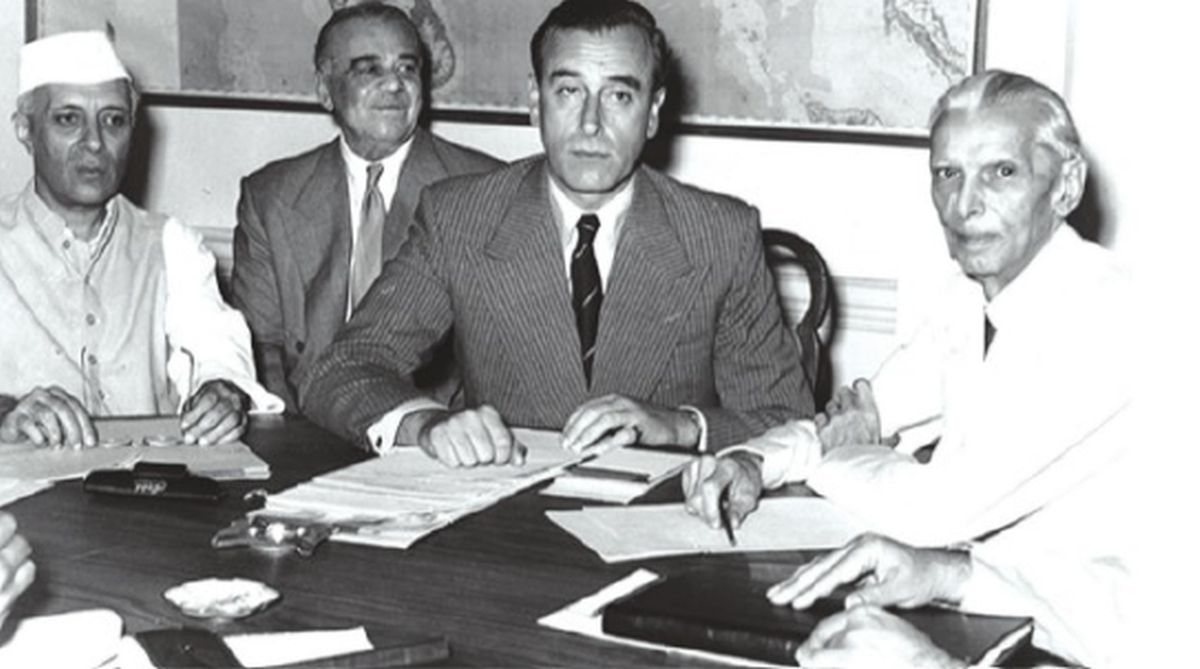
The Great Calcutta Killings and the Week of the Long Knives
On August 16, 1946, the city of Kolkata—then widely known as Calcutta—experienced its most violent and bloodiest convulsions. This marked the beginning of the infamous "week of long knives," an unprecedented orgy of widespread looting, cold-blooded murder, brutal rapes, and systemic molestation. These horrific acts were unleashed upon the city's completely unsuspecting Hindu population by Muslim League strongmen and organized goons.
The catastrophic violence left more than 7,000 people dead, tens of thousands permanently maimed, and an estimated 1.2 lakh citizens entirely homeless. This wave of terror started directly with the aggressive call for "Direct Action Day" issued by the Muslim League supremo, Muhammad Ali Jinnah.
Very few people today are aware of Gopal Chandra Mukhopadhyay, the braveheart who courageously turned the tide against the aggressive onslaught of the Muslim League. He single-handedly saved tens of thousands of Hindus from certain annihilation, effectively defeating the League's diabolical pogrom. Had it not been for his strategic intervention and the ultimate sacrifices of his patriotic band of followers, Calcutta and its neighboring Hindu-majority districts would have been utterly drained of their Hindu population and forcibly made a part of East Pakistan.
Because of this, August 18 ought to be celebrated as a red-letter day for Kolkata in particular, and Bengal in general. Yet, exceptionally few remember this date, which marked the definitive turning point in the gory events that overtook the city. It was the dramatic, resilient turn of events starting from August 18, 1946, that ultimately rescued the metropolis and greater Bengal from being absorbed into Pakistan.
|
|
The Political Prelude: From the Cabinet Mission to Jinnah's Ultimatum
In early 1946, the Cabinet Mission was sent to India by the British government. Its explicit purpose was to find a peaceful resolution to the growing conflict between the Indian National Congress (INC) and the Muslim League regarding the structural framework of post-independence India. These two political entities were the largest and most influential parties within India’s newly formed Constituent Assembly.
The Muslim League adamantly demanded a completely separate homeland for Muslims, which they named "Pakistan," whereas the Indian National Congress firmly envisioned a united, secular India. After several intense rounds of negotiations, the Cabinet Mission’s comprehensive plan for the division of power was initially accepted by both political parties. However, mutual trust was deeply lacking, and the Muslim League remained highly suspicious of the Congress's long-term intentions.
The fragile consensus shattered completely on July 10, 1946. On that day, the newly elected Congress President, Jawaharlal Nehru, held a major press conference in Bombay (now Mumbai). Nehru openly declared that the Congress reserved the right to change and modify the Cabinet Mission Plan according to the evolving situational demands, though they still agreed to participate in the Constituent Assembly.
This public declaration infuriated Muhammad Ali Jinnah. Feeling betrayed, the Muslim League officially refused to participate in the Constituent Assembly, fearing that their core demands would be systematically undermined and outvoted by the Congress majority. This specific political flashpoint caused Jinnah to adopt a completely rigid, unyielding stance, demanding nothing less than an "independent and sovereign" separate Muslim-majority nation via the physical division of India.
"Either a divided India or a destroyed India"
These bloodcurdling words were uttered with absolute defiance by the leader of the All India Muslim League, Muhammad Ali Jinnah. The statement sent immediate chills down the spines of citizens across the subcontinent. To enforce this demand, the Muslim League Council officially proclaimed August 16, 1946, as "Direct Action Day," aiming to aggressively accentuate their demand for a separate Muslim homeland before the British left the Indian subcontinent. Their singular, unwavering objective was to attain an entirely different country governed by a Muslim majority.
 The Religious Connotation: The Battle of Badr and the Call to Arms
In the days leading up to the crisis, Jinnah openly declared his intention to break all constitutional bounds, stating that he was going to "create trouble" and pledging, "I will have India divided or India burned." The general strike, or hartal, called for August 16, 1946, was designed to demonstrate the absolute resolve of the Muslim community to the British authorities regarding the mandatory creation of Pakistan.
The specific date of August 16 was chosen with utmost care and calculation to deliberately provoke intense Islamist sentiments. In 1946, this date coincided precisely with the eighteenth day of the holy month of Ramzan. Historical Islamic texts note that it was on this exact spiritual date that Prophet Muhammad waged the famous Battle of Badr, which resulted in his first decisive, miraculous military victory over the pagan heathens, paving the way for the subsequent conquest of Mecca. Islamists historically celebrate the victory of Badr as the definitive, foundational triumph for the expansion of Islam.
Using this potent symbolism, the then Muslim League Chief Minister of Bengal, Huseyn Shaheed Suhrawardy, systematically organized a massive, pre-planned pogrom against the Hindu residents of Calcutta. The leadership made it clear that they had officially bidden "goodbye to constitutional methods."
Reinforcing this aggressive stance, Mr. Liaquat Ali Khan explicitly told the Associated Press of America that Direct Action meant "resorting to non-constitutional methods, and that can take any form and whatever form may suit the conditions under which we live." He further clarified the League's position by adding, "We cannot eliminate any method. Direct Action means any action against the law." Simultaneously, Sardar Abdul Rab Nishtar openly stated that Pakistan could only be achieved through the shedding of blood, proclaiming that if the opportunity arose, the blood of non-Muslims must be shed, because "Muslims are no believers in ahimsa."
|
Suhrawardy, according to contemporary accounts, operated as an administrative bully who believed entirely in the utility of violence, maintaining a large, organized army of goons at his disposal to enforce his political writ. Historical critics highlight that he was highly corrupt, lacked basic administrative skills, and harbored a visceral hatred for the Hindu population, whom he viewed as infidels who needed to be thoroughly subdued, driven out, or eliminated. Suhrawardy’s personal diaries further confirm his hardline Islamist ideology, revealing a desire to eventually turn the entire Indian subcontinent into an Islamic state.
In the days leading up to August 16, provocative posters featuring Jinnah posing aggressively with a sword were widely distributed across Calcutta. The text on these leaflets read:
"The sword of Islam must be shining on the heavens and will subdue all evil designs… We Muslims have had the Crown and have ruled. Do not lose heart. Be ready and take your swords. Think you, Muslims, why we are under the kafirs today. The result of loving the kafirs is not good. O kafir! Do not be proud and happy. Your doom is not far and the general massacre will come. We shall show our glory with swords in hands and will have a special victory."
Another widely circulated leaflet explicitly instructed Muslims to enter the arena with weapons and rapidly escalate their tactics:
"We shall then see who will play with us, for rivers of blood will flow. We shall have the swords in our hands and noise of takbir. Tomorrow will be the doom’s day."
Suhrawardy and his senior Muslim League colleagues delivered fiery, emotional public speeches, repeatedly reminding the Muslims of Bengal of the ancient victory of Badr. They exhorted their listeners to follow directly in those footsteps to wrest a total victory for Islam on August 16. Syed Muhammad Usman, the then Mayor of Calcutta, issued a widely circulated leaflet containing the overt threat:
"Kafer! Toder dhongsher aar deri nei! Sarbik hotyakando ghotbei!" (Infidels! Your end is not far away! You will be completely massacred!)
|
In his seminal historical work, India’s Partition: The Story of Imperialism in Retreat, historian Devendra Panigrahi quotes the August 13, 1946, issue of the official Muslim League mouthpiece, The Star of India. The newspaper gave detailed, explicit religious instructions on how the population should observe "Direct Action Day," writing:
"Muslims must remember that it was in Ramzan that permission for jehad was granted by Allah. It was in Ramzan that the Battle of Badr, the first open conflict between Islam and heathens, was fought and won by 313 Muslims and again it was in Ramzan that 10,000 Muslims under the Holy Prophet conquered Mecca and established the Kingdom of Heaven and the commonwealth of Islam in Arabia. The Muslim League is fortunate that it is starting its action on this Holy month and day."
Muslim League leaders strictly instructed clerics across the city's mosques to deliver highly charged sermons immediately following the mandatory jumma namaz (Friday prayers), as August 16 fell on a Friday. The clerics complied completely, reminding their large congregations of the historical significance of the day and openly exhorting them to cleanse Bengal of kafirs (infidels).
Even before the formal Friday prayers concluded, organized groups of Muslims began launching targeted attacks on Hindu-owned shops and business establishments that had dared to remain open in defiance of the Muslim League’s official strike call. Following the conclusion of prayers, a massive, agitated crowd of tens of thousands of Muslims streamed directly toward the Ochterlony Monument (known today as the Shahid Minar) to attend a massive political rally headlined by Suhrawardy and other prominent League leaders.
The speakers delivered a series of incendiary speeches, urging the crowd to attack Hindus and systematically drive them out of Calcutta so that Jinnah’s ultimate dream of incorporating the entirety of Bengal into Pakistan could be realized. Crucially, during his speech, Suhrawardy explicitly assured the massive gathering that he had personally seen to it that both the local police force and the military would be completely "restrained." This public assurance was universally construed by the mob as a direct green light to attack, pillage, and murder the Hindu population without fear of legal consequences.
|
The Secret Blueprint for Total Annihilation
To ensure the complete subjugation of the population, a highly confidential, detailed secret circular was systematically distributed among Muslim League networks, outlining a radical, multi-stage plan for total dominance:
All Muslims of India should die for Pakistan.
With Pakistan established, the whole of India should eventually be conquered.
All people of India should be systematically converted to Islam.
All Muslim kingdoms should join hands with the Anglo-American exploitation of the whole world.
One Muslim should get the legal right of five Hindus, establishing that each Muslim is equal to five Hindus.
Until the final establishment of Pakistan and a broader Indian Islamic Empire, the circular ordered that the following immediate tactical steps must be taken:
All factories and shops owned by Hindus should be burnt, destroyed, and looted, with the captured loot given directly to the League Office.
All Muslim Leaguers should carry lethal weapons in open defiance of any government orders.
All nationalist Muslims, if they refuse to join the Leaguers, must be quietly liquidated by a secret Gestapo.
Hindus should be murdered gradually, ensuring their overall population is drastically reduced.
All Hindu temples must be thoroughly destroyed.
Muslim League spies must be thoroughly established in every single village and district across India.
Congress Leaders should be systematically murdered, at a rate of one leader per month, utilizing completely secret methods.
Congress upper offices should be destroyed by a secret Muslim Gestapo, utilizing single individuals to execute the jobs.
Major economic hubs including Karachi, Bombay, Calcutta, Madras, Goa, and Vizagapatam must be completely paralyzed by December 1946 by trained Muslim League volunteers.
No Muslim should ever be allowed to work under Hindus in the Army, Navy, Government services, or private firms.
Muslims must actively sabotage the whole of India and the Congress Government to pave the way for a final, decisive invasion of India.
Financial resources are to be provided directly by the Muslim League. The final invasion of India will be supported by the Nizam, communists, select Europeans, the Khoja of Bhopal, select Anglo-Indians, Parsis, and Christians. The Punjab, Sind, and Bengal will serve as the primary manufacturing hubs for all arms and weapons.
All arms and weapons should be distributed thoroughly to the Bombay, Calcutta, Delhi, Madras, Bangalore, Lahore, and Karachi branches of the Muslim League.
All sections of the Muslim League must carry a minimum equipment of weapons, at least a pocket knife at all times, to destroy Hindus and drive them out of India.
All available transport must be used exclusively for the battle against Hindus.
Hindu culture should be systematically destroyed.
All Leaguers should try to be cruel at all times to Hindus, enforcing a strict social, economic, and cultural boycott against them.
No Muslim should ever buy goods from Hindu dealers, and all Hindu-produced films must be completely boycotted. All Muslim Leaguers must strictly obey these instructions and bring them into full action by September 15, 1946.
|
The Orchestrated Massacre: A One-Sided Orgy of Violence
On the afternoon of August 16, 1946, the political gathering at the Ochterlony Monument swelled to an immense size, with historical estimates ranging between 60,000 and 200,000 people. It stood as the single largest assembly of Muslims in the history of undivided Bengal's capital city.
Prominent Muslim League leader Khwaja Nizamuddin—who would later assume the role of Governor-General of Pakistan following Jinnah’s demise—was among the first to address the massive rally. He intentionally laid the tactical groundwork for violence by falsely alleging to the crowd that Hindus had aggressively attacked peaceful Muslims earlier that morning, claiming that the Muslim community was merely retaliating in pure self-defense.
Suhrawardy then delivered his fiery, emotional address, calling for the immediate creation of Pakistan and fiercely urging the crowd to fight to the death for it. He led the massive crowd in chanting aggressive political slogans:
"Maar ke lenge Pakistan, lad ke lenge Pakistan, le kar rahenge Pakistan, Allahu Akhbar, nara-i-takhbir." (We will kill and fight to create Pakistan, we are absolutely determined to create Pakistan.)
According to official intelligence reports filed by British operatives immediately after the rally, Suhrawardy explicitly told the highly agitated crowd that he had personally ensured the police and military forces would not intervene in any upcoming actions. This was universally interpreted as an open, state-sanctioned call for violence.
Even Banglapedia, the official National Encyclopedia of Bangladesh—a historical publication where Suhrawardy is traditionally treated as a highly revered political figure—explicitly records that Suhrawardy informed the gathering that the police and army had been fully "restrained." In practical terms, this meant that the state apparatus was ordered to deliberately look the other way, ensuring they would not interfere when armed mobs launched their attacks.
Armed with heavy iron rods, sharp swords, and an array of lethal weapons, the agitated mobs streamed out of the rally venue, fanning out into different sectors of the city. A prominent gunsmith shop selling arms and ammunition owned by a Hindu businessman at Esplanade, located directly adjacent to the rally ground, was the very first target attacked. The owner and his entire staff were brutally decapitated on the spot.
What followed immediately was a horrific, entirely one-sided orgy of extreme violence. Thousands of Hindu homes and commercial shops were systematically ransacked, looted, and set ablaze. Hindu men and young boys were subjected to horrific massacres, with public decapitation and the systematic amputation of limbs serving as the mob's preferred methods of brutality. Concurrently, Hindu women were subjected to horrific mass scale disrobing, public gang-rapes, and murder, with hundreds being forcibly abducted to be kept as captive sex slaves.
One of the single worst atrocities of the entire week occurred at the Kesoram Cotton Mills, located at Lichubagan in the heavily Muslim-dominated Metiabruz district. A prominent Muslim League leader named Syed Abdullah Farooqi personally led a massive, armed mob directly inside the residential compound of the mill.
The compound housed approximately 600 poor Hindu laborers, the vast majority of whom were migrant workers from Odisha. The mob systematically cornered and beheaded nearly all of them. Only two individuals survived the horrific slaughter to testify to the sheer brutality; both men had their arms completely hacked off by swords and were left in piles of corpses for dead, but miraculously managed to survive.
|
Just as Suhrawardy had confidently predicted to his inner circle, the Hindu population offered virtually no organized resistance during the first two days of the slaughter. Suhrawardy had previously assured his political colleagues that centuries of continuous Muslim rule had thoroughly numbed the Hindu population into complete submission. He maintained that Hindus lacked the basic courage to stand up and fight, even though they constituted a clear majority within the city itself.
In 1946, the demographic reality of Calcutta was 64 percent Hindu and 33 percent Muslim, with neighboring industrial districts like Howrah and Hooghly also maintaining decisive Hindu majorities. Suhrawardy insisted to his colleagues that after generations of historical domination, Hindus simply "did not have it in their genes to resist Muslims," and that "Hindus were of the firm belief that they were weak and Muslims were strong and ferocious."
To personally oversee the execution of this strategy, Suhrawardy stationed himself directly inside the central control room of the Calcutta Police Headquarters at Lalbazar. From this vantage point, he actively used his executive authority to physically restrain British and Anglo-Indian police officers from deploying armed units to areas where Muslim mobs were successfully killing and looting Hindus.
Months prior to the attack, Suhrawardy had quietly altered the entire demographic composition of the city's police constabulary. He systematically terminated or transferred large numbers of Bihari Hindu officers, replacing them with Pathans and hardline Muslim constables recruited heavily from the United Provinces (now Uttar Pradesh). During the riots, these newly inducted Muslim constables actively aided the criminal mobs, participating in the murder of Hindu men and the state-sanctioned butchery of women.
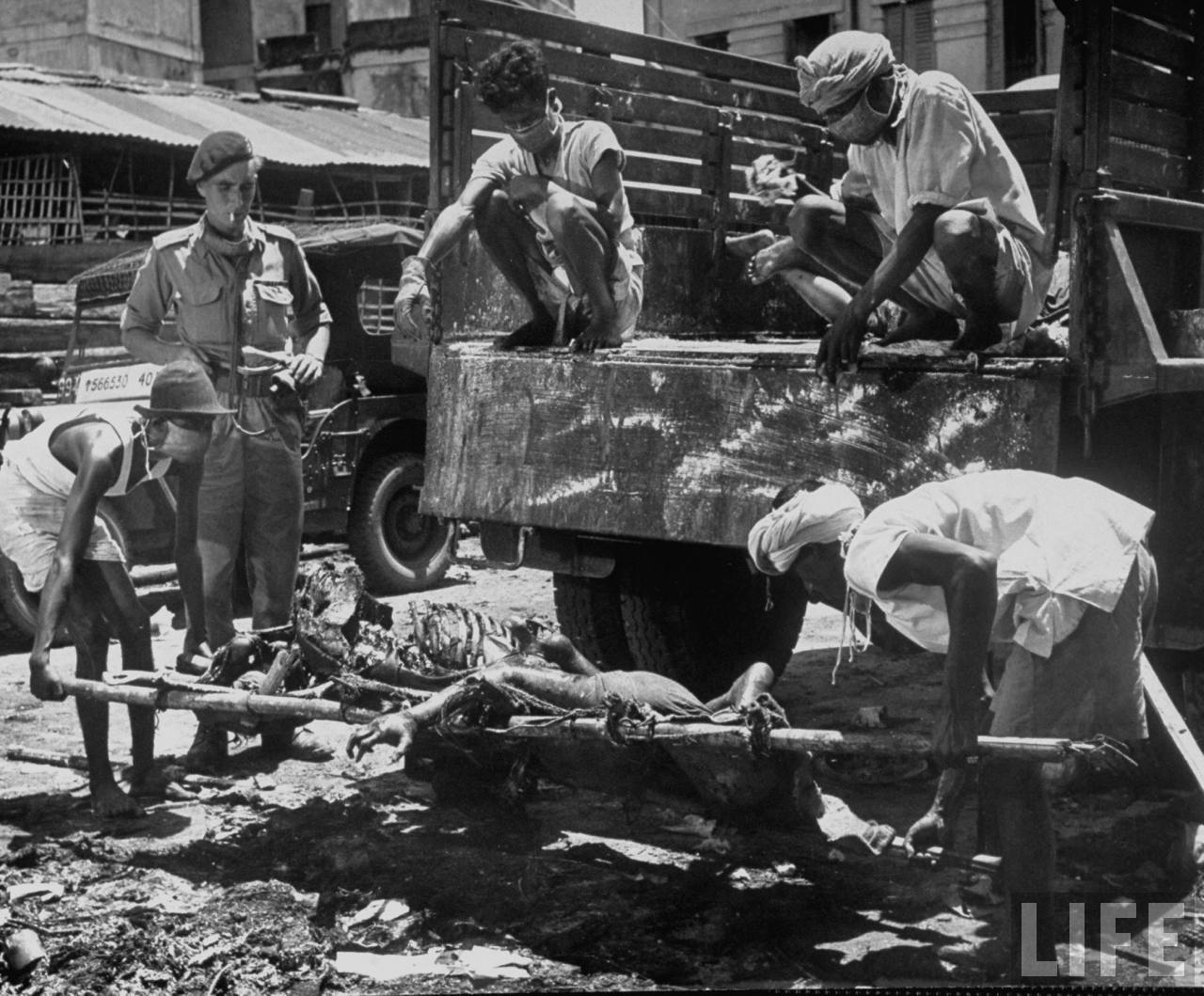
Throughout August 16 and 17, the targeted killings concentrated heavily within Hindu-majority neighborhoods, resulting in the deaths of thousands of citizens in less than 48 hours. While initial estimates varied wildly between 4,000 and 20,000, official records show that approximately 3,500 bodies of Hindu victims were formally recovered and cremated.
However, contemporary British and Indian historians have extensively documented that a far larger number of victims were stuffed into the city's extensive underground storm sewers or simply dumped into the Ganges and the various industrial canals crisscrossing the metropolis. A highly conservative estimate places the true number of Hindus killed or permanently missing during these first two days well over 7,000.
Faced with absolute annihilation, a massive wave of terrified Hindu refugees began fleeing Calcutta. Howrah Station quickly transformed into a desperate mass of humanity, packed with families trying to board any train leading out of the province. Hundreds of families attempted to escape across the Hooghly River in small country boats, but were systematically drowned when Muslim League operatives manning heavy industrial barges deliberately rammed the smaller vessels.
This total terror campaign matched Suhrawardy’s strategic goal: to inflict such an extreme psychological trauma that Hindus would permanently abandon Calcutta, shifting the city's demographics into a decisive Muslim majority. Achieving a Muslim-majority Calcutta would provide the Muslim League with an unassailable geopolitical justification to demand the city's permanent inclusion into Pakistan.
Suhrawardy’s broader plan was to secure Calcutta first, then immediately unleash his armed cadres onto the prosperous neighboring Hindu-majority districts of Howrah, Hooghly, and the 24 Parganas. These heavily industrialized regions drove the entire economy of Bengal. The League leadership fully realized that without these wealthy industrial zones, a future East Pakistan would be economically unviable. It was therefore deemed imperative to either drive the Hindu population out of these zones or terrorize them into total political submission.
|
The Rise of Gopal Patha and the Great Counter-Offensive
It was at this exact, existential juncture—with the Muslim League's plan to reduce Calcutta's Hindus to a helpless minority nearing total success—that Gopal Chandra Mukhopadhyay emerged to completely reverse the course of history. Then a vibrant 33-year-old, Gopal was born into a respected, deeply nationalist Bengali Hindu Brahmin family residing at Malanga Lane in the Bowbazar district of Kolkata.
He was an ardent, lifelong follower of Netaji Subhas Chandra Bose and harbored a deep intellectual aversion to Gandhian philosophies of non-violence when facing existential terror. Gopal was also the nephew of Revolutionary Professor Anukul Chandra Mukhopadhyay, a nationalist thinker and celebrated professor of philosophy at Allahabad University who would later be honored with the Padma Bhushan in 1964.
Gopal operated a successful family mutton shop in the commercial district, which earned him the affectionate local street nickname Gopal "Patha" ("Patha" meaning male goat in the Bengali language). Modern historical researchers emphasize that Gopal maintained excellent professional relationships with Muslim livestock traders and goat rearers, bearing no personal ill will or religious animosity toward ordinary Muslims.
From his youth, he was a dedicated philanthropist, known for using his personal resources to help local families in distress. Gopal had already founded and funded the Bharat Jatiya Bahini, a disciplined nationalist organization composed of robust young men—many of whom were trained traditional wrestlers (pahlwans)—dedicated to performing community defense and disaster relief work.
|
On the night of August 17, as horrific eyewitness reports of the large-scale massacres of Hindus and the mass rapes of women began filtering into Bowbazar, Gopal realized that complete reliance on the state or police would mean total annihilation. He immediately called upon the Hindu youth of Calcutta and the members of the Bharat Jatiya Bahini to mobilize for active physical resistance. His directive to his men was simple, direct, and uncompromising: they must pay back the Islamist terrorists who come to attack innocent families in their own coin.
Throughout the night of August 17, Gopal and his close military-style associates sat over maps of the city, chalking out a highly detailed, defensive counter-action plan to seal off Hindu neighborhoods. Word of Gopal’s organized self-defense strategy spread rapidly through the terrified city, prompting hundreds of non-Bengali Hindu youths from Bihar and the United Provinces—who had also been targeted by the mobs—to join his ranks.
Simultaneously, wealthy Marwari traders of the Burrabazar district, who had suffered catastrophic financial losses from the League's arson attacks, stepped forward to provide unlimited financial backing. Hindu blacksmiths across the city worked through the night in their foundries, manufacturing thousands of heavy swords, spears, iron rods, choppers, and meat cleavers entirely free of cost for Gopal's defense force.
Furthermore, as a precautionary measure following the conclusion of World War II, several Marwari businessmen had previously purchased a collection of surplus pistols, ammunition cartridges, and combat grenades from American soldiers stationed in Calcutta. This entire tactical cache was turned over to Gopal’s central command. Gopal served as a major unifying force, successfully rallying common citizens—including local milkmen, vegetable vendors, manual laborers, and shopkeepers—into a coordinated resistance movement against the terror campaign.
Gopal recognized that if the counter-strike was not executed with decisive ferocity, the Hindu population of Calcutta would be completely wiped out, leading to total ethnic cleansing and the inevitable absorption of the metropolis into Pakistan. His strategic calculations were meticulous. He explicitly instructed his young squads that if the Muslim League forces killed a single Hindu citizen, the resistance must retaliate by eliminating ten League combatants. He viewed this strict asymmetry as the only viable psychological method to break the morale of a numerically superior adversary.
The Muslim League possessed hundreds of thousands of mobilized men acting under state protection; the Hindu community possessed only Gopal Patha and his dedicated bands of local youths. Crucially, however, unlike the unscrupulous methods deployed by the League's leadership, Gopal issued a strict standing order to his forces: under no circumstances were they to harm Muslim women, children, or the elderly, and they were strictly forbidden from engaging in the despicable tactics of kidnapping or rape.
|
Turning the Tide: The Ferocious Counter-Attack of August 18
By the early dawn hours of August 18, compact, heavily armed formations of Hindu youths stood fully prepared within their respective localities, waiting to confront incoming mobs. Unaware of this massive mobilization, Suhrawardy and his lieutenants began directing their armed cadres back into Hindu residential zones that morning.
Suhrawardy assured his inner circle that they had exactly forty-eight hours left to complete the total ethnic cleansing of Calcutta, as political pressure was rapidly mounting in New Delhi due to reports reaching the Viceroy. Anticipating an imminent military intervention by the Viceroy, Suhrawardy ordered his men to maximize casualties on August 18 before shifting their operations to the three surrounding industrial districts over the following two days.
However, as the League's mobs advanced on the morning of August 18, they received a massive shock. Celebrated historian Sandip Bandopadhyay, who conducted extensive archival research on the life of Gopal Mukhopadhyay, writes:
"They faced resistance everywhere. Hindu youths counter-attacked with such ferocity that the Muslim League men had to flee. Many were killed. Emboldened by their success in taking on and defeating their Islamist attackers, Hindu youths took the fight to Muslim-majority areas and started killing Islamist men. They did not, however, touch Muslim women and children or the aged and the infirm. Gopal was never communal. He simply organised self-defence of Hindus by organising Hindu youths to fight back Islamist aggression. He gave shelter to the homeless and widows and stopped them from getting killed or converted."
Over the subsequent three days—spanning August 18 to August 20—the Muslim League's cadres were thoroughly defeated using their own methods. Every single League organizer, neighborhood thug, or mob leader who had participated in the initial two days of anti-Hindu violence was systematically identified, hunted down, and eliminated. Absolute panic swept through the Muslim League leadership as their forces realized they were no longer safe on the streets of Calcutta.
By August 19, the entire tide of the conflict had completely reversed. The very men who had carried out the initial massacres found themselves entirely on the defensive. Suhrawardy, his political associates, and the highly biased partisan officers of the Calcutta Police stood completely powerless to halt the momentum of the Hindu resistance.
While the strategic planning of this massive counter-offensive was directed by Gopal Mukhopadhyay and key local figures like Basanta—a famously powerful traditional wrestler from Beadon Street near Bowbazar—the heavy physical muscle of the resistance was proudly provided by Dalit communities and tough non-Bengali Hindu working-class migrants from Bihar and the United Provinces.
Financially sustained by the trading families of Burrabazar, these combined forces shattered the deeply held illusion within the Muslim League that the Hindu community was inherently meek, effectively instilling a profound fear in the hearts of the planners who had assumed annihilation would be simple.
The Collapse of Suhrawardy's Blueprint
Suhrawardy, who had confidently operating on the theory that Hindus lacked the genetic capability to resist violence, suffered a massive psychological shock. British police records from the period document that on the evening of August 19, Suhrawardy was observed pacing inside the Lalbazar Police Headquarters in a state of absolute, visible breakdown—holding his head in his hands and repeatedly muttering that he could never have conceived that the Hindu population would fight back with such devastating efficiency.
His sinister administrative plan to engineered a total Hindu exodus from Calcutta and its surrounding industrial districts lay in complete ruins. Suhrawardy stood thoroughly defeated, his political ambitions broken primarily by the operational brilliance of Gopal Mukhopadhyay.
By August 21, when direct Viceroy’s rule was officially imposed over Bengal, Suhrawardy’s government was unceremoniously dismissed. As elite British and Gurkha military regiments deployed across the city to enforce peace, final casualty data revealed that during the final days of the conflict, more Muslim League combatants had been killed during the counter-offensive than Hindu victims during the initial massacres.
In a desperate bid to save his political career and halt the destruction of his remaining political cadres, Suhrawardy personally dispatched G.G. Ajmeri and Sheikh Mujibur Rahman—the prominent student muscleman of the Muslim League’s wing and the Muslim National Guard, who would much later become the foundational creator of Bangladesh—to humbly sue for peace. They personally approached Gopal Mukhopadhyay at his central command post, pleading for an immediate ceasefire.
Gopal agreed to halt his forces under one strict condition: the Muslim League must completely disarm its remaining killing squads and entirely cease all hostile actions against Hindu neighborhoods first. Facing total elimination on the streets, Suhrawardy complied immediately.
Historians note that Suhrawardy was not only driven into a corner by the raw power of the Hindu resistance, but he also realized that the British Viceroy, Lord Archibald Wavell, had reached the absolute limit of his patience. Suhrawardy feared that the immediate dismissal of his Muslim League government would destroy his party's leverage on the eve of India's independence. He panicked, using the truce to preserve his remaining institutional influence. However, his political maneuvering proved too late; Lord Wavell officially dissolved the League-led provincial government on August 21, 1946.
The Mathematical Reality: How Calcutta Was Saved from East Pakistan
To fully comprehend the historical magnitude of Gopal Mukhopadhyay’s resistance, it is necessary to analyze the demographic and mathematical data of the era. In 1946, the total population of Calcutta stood at approximately 20 lakhs. Within this population, there were roughly 12.8 lakh Hindus and 6.6 lakh Muslims.
Crucially, out of the 12.8 lakh Hindu residents, approximately 30 percent (or 3.84 lakhs) consisted of non-Bengali migrant laborers. Had the Muslim League succeeded in forcing a geopolitical referendum on whether Calcutta should join East Pakistan, these non-Bengali residents would have been legally classified as temporary provincial migrants, completely stripping them of voting rights.
By the late night of August 17, approximately 7,000 Hindus had already been massacred, sparking a massive, chaotic exodus of Bengali Hindus out of the metropolitan area. Modern sociological research specializing in genocides and ethnic cleansing reveals a consistent mathematical ratio: the targeted killing of every 100 individuals within an ethnic group automatically triggers the immediate panic-flight of at least 4,000 others.
Following this established ratio, if Gopal Patha had not launched the counter-offensive and the massacres had been allowed to proceed unhindered for just two more days, the Hindu death toll would have easily risen by an additional 5,000 victims, bringing the total dead to over 12,000.
This scale of slaughter would have triggered an unstoppable mass exodus of over 5 lakh Bengali Hindus from the city. Combined with the dead, the total Hindu population inside Calcutta would have plummeted to less than 7.8 lakhs—bringing it nearly level with the existing Muslim population.
| Demographic Metric (1946) | Original Figures | Projected Outcome (Without Gopal Patha) |
| Total Hindu Population | 12.8 Lakhs | ~7.8 Lakhs (Due to Massacre and Exodus) |
| Total Muslim Population | 6.6 Lakhs | ~10.6 Lakhs (Due to Planned Influx) |
| Demographic Status | Hindu Majority (64%) | Muslim Majority (~57%) |
To cement this demographic shift, Suhrawardy and his planning committees had already organized an immediate follow-up program to systematically import over 4 lakh Muslims from the heavily overpopulated rural hinterlands of Eastern Bengal. These incoming families were to be immediately settled into the properties, commercial shops, and residential quarters abandoned by the dead or fleeing Hindus.
This coordinated demographic colonization was designed to permanently transform Calcutta and its immensely wealthy, industrialized neighboring districts into a solid Muslim-majority zone. This transformed demographic data would have presented the British boundary commissions with an unassailable argument for the mandatory inclusion of Calcutta into East Pakistan.
The Historical Consequences: The Persecution of Hindus in East Bengal
Had Suhrawardy’s geopolitical game plan succeeded, it would have spelled absolute disaster for the entire Bengali Hindu population. The loss of Calcutta and its neighboring economic zones would have permanently rendered millions of Bengali Hindus completely stateless and homeless.
Furthermore, verified historical population data collected over the subsequent decades conclusively demonstrates that the Hindu minority has never been safe under a Muslim-majority governance framework in East Bengal, experiencing continuous discrimination, systemic massacres, institutionalized rapes, forced conversions, and state-sanctioned land theft.
The demographic decline of the Hindu population within the region that evolved from East Bengal to East Pakistan, and ultimately to modern Bangladesh, is documented by official census records:
1901: Hindus comprised 33% of the population.
1911: Decreased to 31.5%.
1921: Decreased to 30.6%.
1931: Decreased to 29.4%.
1941: Decreased to 28%.
Following the partition of 1947, under the administration of East Pakistan, the institutional targeting of Hindus accelerated sharply. The census numbers reveal a steep, continuous drop:
1951: Dropped to 22.05% of the population.
1961: Dropped to 18.5%.
1974: (Following the creation of Bangladesh) Dropped to 13.5%.
1981: Dropped to 12.13%.
1991: Dropped to 10.51%.
2001: Dropped to 9.2%.
2011: Dropped to 8.96%.
Demographic models indicate that by 2031, the Hindu population within Bangladesh is projected to fall below 5 percent. This undeniable statistical trajectory proves that the Hindu population of Calcutta, Howrah, Hooghly, and the 24 Parganas would have faced total cultural and physical erasure had Gopal Mukhopadhyay not broken the momentum of the Muslim League's mobs.
Defying Gandhi: The Refusal to Disarm
Even after the direct threat of the Great Calcutta Killings subsided, the ripples of communal violence continued to flare across various sectors of partitioned India. Recognizing that the underlying structural threats remained unresolved, Gopal Patha firmly refused to dissolve the Bharat Jatiya Bahini, maintaining his organization as an active, armed community defense force.
In 1947, Mohandas Karamchand Gandhi embarked on a high-profile peace tour of Bengal, utilizing his immense political influence to demand that Hindu self-defense groups unilaterally surrender their weapons as a gesture of absolute pacifism. While several prominent political leaders succumbed to Gandhi’s intense moral pressure and emotional "satyagraha" tactics, leaving their communities entirely defenseless, Gopal Patha remained completely unyielding. He viewed Gandhi's demands as dangerously detached from the harsh ground realities of existential survival.
In an intimate interview recorded later in his life, Gopal vividly recounted his direct confrontation with Gandhi's core leadership:
"Gandhi called me twice, I didn’t go. The third time, some local Congress leaders told me that I should at least deposit some of my arms. I went there. I saw people coming and depositing weapons which were of no use to anyone: out-of-order pistols, that sort of thing. Then Gandhi’s secretary said to me: ‘Gopal, why don’t you surrender your arms to Gandhiji?’ I replied, `With these arms, I saved the women of my area, I saved the people. I will not surrender them. Where was Gandhiji, I said, during the Great Calcutta Killing? Where was he then? Even if I’ve used a nail to kill someone, I won’t surrender even that nail."
Gandhi’s strict pacifist doctrines failed to sway a leader who had personally witnessed the reality of the massacres, and who knew that only structured, defensive force had prevented the total erasure of millions of citizens.
Interview of Gopal Patha |
The Erased Legacy of a Forgotten Savior
Were it not for the strategic resistance organized by Gopal Mukhopadhyay and prominent political stalwarts like Dr. Syama Prasad Mookerjee, the state of West Bengal would simply not exist today, and Calcutta would be a foundational territory of a neighboring sovereign Islamic state. Modern Bengali Hindus owe their very geographic existence to these figures.
Yet, contemporary historical narratives have largely forgotten these heroes. Post-independence historical documentation, heavily influenced by specific political narratives emphasizing that India's independence was won exclusively through pacifist means, systematically minimized or omitted the contributions of revolutionary leaders like Bhagat Singh, Shivaram Rajguru, Sukhdev Thapar, and Netaji Subhas Chandra Bose.
Under this same historiographical framework, the horrific realities of the Great Calcutta Killings and the Direct Action Day massacres were largely swept under the rug to preserve specific political narratives. Consequently, the memory of Gopal Chandra Mukhopadhyay was not only neglected, but actively vilified by select academic circles.
Left-leaning historians, such as Joya Chatterji (former Professor of South-Asian History at the University of Cambridge), have gone so far as to publicly denigrate Gopal in mainstream publications like Scroll, labeling him as a "major dacoit" and characterizing him as a cynical "syndicate ganglord with a finger in various pies such as real estate and gambling."
For decades, this rich history remained buried until independent leaders like Tapan Ghosh—the dedicated founder of the Hindu Samhati movement—began a systematic campaign to revive the historical memory of the 1946 resistance. Through organized public educational rallies in Kolkata, which drew over 10,000 youth by 2017, Ghosh successfully raised mass awareness regarding the true scale of the Great Calcutta Killings and Gopal Patha's decisive role in halting the genocide.
The nineteenth-century Spanish philosopher George Santayana famously wrote a warning that remains deeply relevant to contemporary Bengal:
"Those who cannot remember the past are bound to repeat it."
Cultural analysts note that modern West Bengal faces deep demographic and political transitions, drawing parallels to the structural pressures experienced in 1946. As the lessons of history fade from public memory, the legacy of Gopal Patha stands as a vital historical testament to the power of organized community resilience when facing absolute institutional failure.
 Support Us
Satyagraha was born from the heart of our land, with an undying aim to unveil the true essence of Bharat. It seeks to illuminate the hidden tales of our valiant freedom fighters and the rich chronicles that haven't yet sung their complete melody in the mainstream.
While platforms like NDTV and 'The Wire' effortlessly garner funds under the banner of safeguarding democracy, we at Satyagraha walk a different path. Our strength and resonance come from you. In this journey to weave a stronger Bharat, every little contribution amplifies our voice. Let's come together, contribute as you can, and champion the true spirit of our nation.
 |  |  |
| ICICI Bank of Satyaagrah | Razorpay Bank of Satyaagrah | PayPal Bank of Satyaagrah - For International Payments |
If all above doesn't work, then try the LINK below:
DISCLAIMER: The author is solely responsible for the views expressed in this article. The author carries the responsibility for citing and/or licensing of images utilized within the text. The website also frequently uses non-commercial images for representational purposes only in line with the article. We are not responsible for the authenticity of such images. If some images have a copyright issue, we request the person/entity to contact us at This email address is being protected from spambots. You need JavaScript enabled to view it. and we will take the necessary actions to resolve the issue.